Address
304 North Cardinal St.
Dorchester Center, MA 02124
Work Hours
Monday to Friday: 7AM - 7PM
Weekend: 10AM - 5PM
Address
304 North Cardinal St.
Dorchester Center, MA 02124
Work Hours
Monday to Friday: 7AM - 7PM
Weekend: 10AM - 5PM

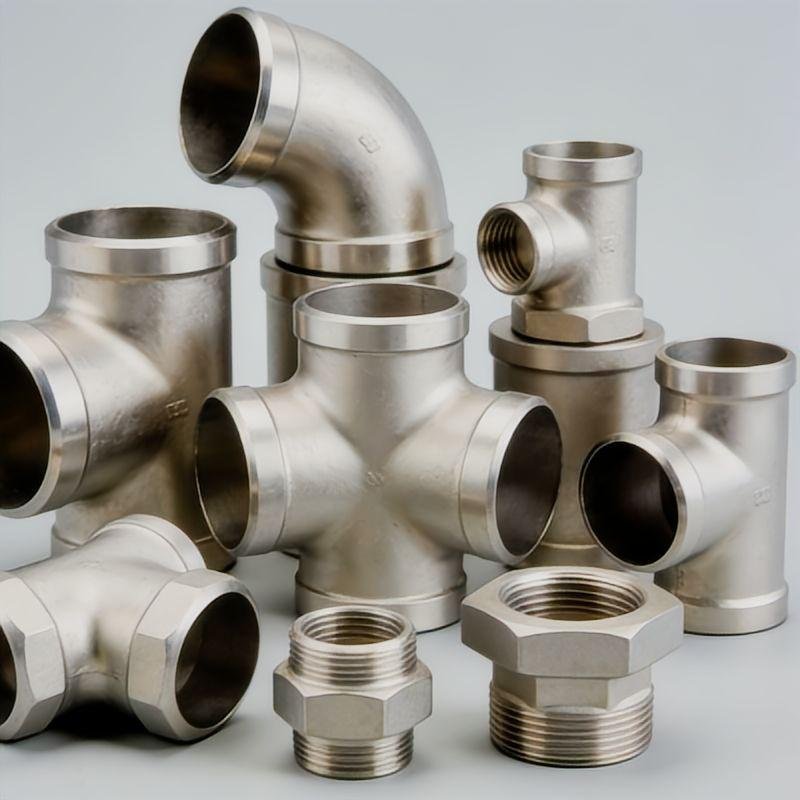
Inconel 718 socket weld fittings to ASME B16.11, UNS N07718. Solution annealed plus aged, 185 ksi min. EN 10204 3.1 MTC, Class 3000/6000/9000.
Inconel 718 socket weld fittings are the age-hardened member of the nickel alloy fitting family, and they behave differently from every other grade on this site. UNS N07718 is a precipitation-hardening nickel-chromium-iron alloy with niobium, titanium and aluminium additions; it is not forged and left soft, but solution annealed and then aged through a controlled cycle, and the result is a minimum tensile strength of 185 ksi (1275 MPa) at a minimum yield of 150 ksi (1034 MPa) with 12 % elongation. That combination of aerospace-level strength with resistance to oxidation, chloride pitting and sour service is not available from any other nickel alloy in the range.
Supplied to ASME B16.11 in the socket weld form, these fittings are used on small-bore lines where a full-penetration weld is wanted but the pipe cannot easily be bevelled, and where the joint has to be inspectable and the component has to carry load. Note at the outset that ASME SB-366 does not list UNS N07718 among its grades, so the material route for these fittings is ASME SB-834 for the pressure consolidated powder metallurgy product, or ASME SB-637 forging stock machined to the B16.11 form. This page covers the socket weld form; the butt weld form is on our Inconel 718 butt weld fittings page and the full nickel alloy range is on our nickel alloy socket weld fittings overview.
| Designation | Value |
|---|---|
| UNS number | N07718 |
| Material specification | ASME SB-834 (pressure consolidated powder metallurgy iron-nickel-chromium and nickel-chromium-iron-columbium-molybdenum alloy pipe flanges, fittings, valves and parts); ASME SB-637 for precipitation hardening and cold worked nickel alloy bars, forgings and forging stock |
| Dimensional standard | ASME B16.11 (forged fittings, socket-welding and threaded) |
| Condition of supply | Solution annealed plus precipitation hardened |
| Solution treatment | 1700 to 1850 °F (924 to 1010 °C), hold 1/2 hour minimum, cooled at a rate equivalent to air cool or faster |
| Precipitation hardening | 1325 ± 25 °F (718 ± 14 °C) for 8 hours, furnace cooled to 1150 ± 25 °F (621 ± 14 °C) and held until total precipitation treatment time reaches 18 hours, then air cooled |
| Delivery condition | Solution annealed plus aged, pickled |
| Element | Composition, % (max unless stated) |
|---|---|
| Nickel | 50.0 – 55.0 |
| Chromium | 17.00 – 21.00 |
| Molybdenum | 2.80 – 3.30 |
| Columbium (Nb) + tantalum | 4.75 – 5.50 |
| Titanium | 0.65 – 1.15 |
| Aluminium | 0.20 – 0.80 |
| Iron | balance, by difference |
| Cobalt | 1.0 |
| Copper | 0.30 |
| Carbon | 0.08 |
| Manganese | 0.35 |
| Silicon | 0.35 |
| Phosphorus | 0.015 |
| Sulfur | 0.015 |
Limits as published for UNS N07718 in ASME SB-834 Table 1, which covers pipe flanges, fittings, valves and parts in this alloy. ASME SB-637 Table 1 publishes the same grade for bars, forgings and forging stock, and ASME SB-834 Table 2 sets the product analysis tolerances. The niobium and tantalum figure is given as a combined limit, which is why the certificate reports niobium with tantalum.
| Condition | Tensile, min ksi (MPa) | Yield (0.2 %), min ksi (MPa) | Elongation, min % |
|---|---|---|---|
| Solution annealed + precipitation hardened | 185 (1275) | 150 (1034) | 12 |
From ASME SB-834 Table 3 for UNS N07718. ASME SB-637 Table 4 gives the same tensile and yield minima with 12 % elongation in 2 in. (50 mm) and 15 % reduction of area, and adds a minimum hardness of 331 HB, equivalent to 36 HRC, in the aged condition. Because that hardness is a requirement of the specification rather than a characteristic of the melt, it is the figure to check against any maximum hardness limit the project applies, particularly in sour service, before the grade is confirmed.
| Item | Requirement |
|---|---|
| Governing dimensional standard | ASME B16.11 |
| Nominal size range covered | NPS 1/8 to NPS 4 (DN 6 to DN 100) |
| End preparation | Socket weld to ASME B16.11; socket depth and bore to suit the pipe OD and wall tolerance |
| Pressure classes | Class 3000, Class 6000 and Class 9000 for socket weld ends |
| Class to pipe wall | Class 3000 with Schedule 80 / XS wall, Class 6000 with Schedule 160 and heavier wall, Class 9000 with the heaviest wall the size allows |
| Common forms | 90° and 45° elbows, tees, crosses, couplings, reducers, caps, plugs and bushings |
| Availability beyond the standard range | TBC against the specific enquiry |
The material is delivered in the solution annealed plus precipitation hardened condition, and that condition is reached in two steps that must both be completed. Solution annealing at 1700 to 1850 °F (924 to 1010 °C) dissolves the carbides and the gamma prime phase into a homogeneous matrix. Precipitation hardening then holds the material at 1325 ± 25 °F (718 ± 14 °C) for 8 hours, furnace cools it to 1150 ± 25 °F (621 ± 14 °C) and holds it there until the total precipitation treatment time reaches 18 hours before air cooling. The strength of the finished fitting is set by the second step, so an under-aged body is not a slightly weaker fitting, it is a different material from the one that was ordered. Forming and machining are completed before the final heat treatment, and the socket is then machined and dimensionally checked.
Fittings are supplied solution annealed and pickled, with a machined surface
finish. Each fitting carries the grade, the governing material specification, the
dimensional standard, the nominal size and the heat number, linked to the
EN 10204 certificate issued with the shipment. Export packing is by wooden
crate, steel pallet or case, with plastic end caps and, where required, VCI
protection inside the case. Beveled or plain ends are confirmed with the
order. Delivery schedule, quantity, minimum order quantity and price are
confirmed only against a specific enquiry.
The weld joint does not inherit the aged properties. This is the single most important thing to understand about 718. The strength of the parent metal comes from a fine dispersion of a nickel-niobium precipitate formed during ageing, and the heat-affected zone of a welded joint is heated well above the ageing temperature and then cools through the precipitation range without ever being held at it. The result is a joint that is stronger than the unaged material but weaker than the aged parent, and no filler selection can change that, because filler chemistry controls strength in the weld metal, not in the heat-affected zone. Where full aged strength has to be carried through the joint, the answer is a machined component that is not welded, or a post-weld solution and ageing cycle that the fabricator and the code allow.
718 is weldable, and it is crack resistant when welded properly. The alloy is a deliberate choice for welded structures precisely because it resists strain age cracking and hot cracking in the heat-affected zone far better than the precipitation hardening grades that came before it. But that resistance depends on controlling heat input and interpass temperature, and on keeping the heat-affected zone clean. Contamination of the nickel-rich surface with copper-bearing material, or with sulphur, is the classic way to manufacture a cracking problem in a nickel alloy that is supposed to be crack resistant.
The hardness requirement cuts both ways. ASME SB-637 makes a minimum hardness of 331 HB, or 36 HRC, part of the aged condition, because that is the hardness that comes with the precipitate. The same hardness is what a sour-service specification typically limits, so an aged 718 fitting and a maximum-hardness sour requirement can be in direct conflict. Resolve this on the enquiry, in writing, against the actual governing document, rather than discovering it at the manufacturing stage.
Temperature capability is not the same as creep capability. 718 is often described simply as a high-temperature alloy, and it is qualified for service to about 700 °C. The distinction that matters in design is between the alloy being able to sit at a temperature and the component being able to hold a stress at that temperature for a long time. The strength of 718 at 700 °C is well below its room temperature strength, and it is the long-term rupture behaviour, not the short-term tensile behaviour, that governs a pressure boundary design.
ASME SB-834 covers UNS N07718 pipe flanges, fittings, valves and parts in the pressure consolidated powder metallurgy form, and ASME SB-637 covers the precipitation hardening bar, forgings and forging stock from which fittings are machined. ASME SB-366 does not list UNS N07718 among its grades.
Solution annealed plus precipitation hardened. Solution annealing at 1700 to 1850 °F, then 1325 ± 25 °F for 8 hours with a furnace cool to 1150 ± 25 °F held to a total of 18 hours, then air cooling.
A minimum tensile strength of 185 ksi (1275 MPa) and a minimum yield strength of 150 ksi (1034 MPa) with 12 % elongation, per ASME SB-834 Table 3. ASME SB-637 adds a minimum hardness of 331 HB (36 HRC) in the aged condition.
No. The heat-affected zone of a welded joint does not receive the ageing treatment and does not reach the strength of the aged parent metal. Where that matters, the design should avoid a welded joint or allow a post-weld treatment cycle.
The alloy resists chloride pitting and H2S attack well, but the aged condition carries a specified minimum hardness. Confirm that the hardness requirement of the governing sour-service document is compatible before the grade is confirmed.
ASME B16.11 designates socket weld end fittings as Class 3000, Class 6000 and Class 9000. The class must match the pipe wall, since the class describes the pairing rather than a pressure in isolation.