Address
304 North Cardinal St.
Dorchester Center, MA 02124
Work Hours
Monday to Friday: 7AM - 7PM
Weekend: 10AM - 5PM
Address
304 North Cardinal St.
Dorchester Center, MA 02124
Work Hours
Monday to Friday: 7AM - 7PM
Weekend: 10AM - 5PM

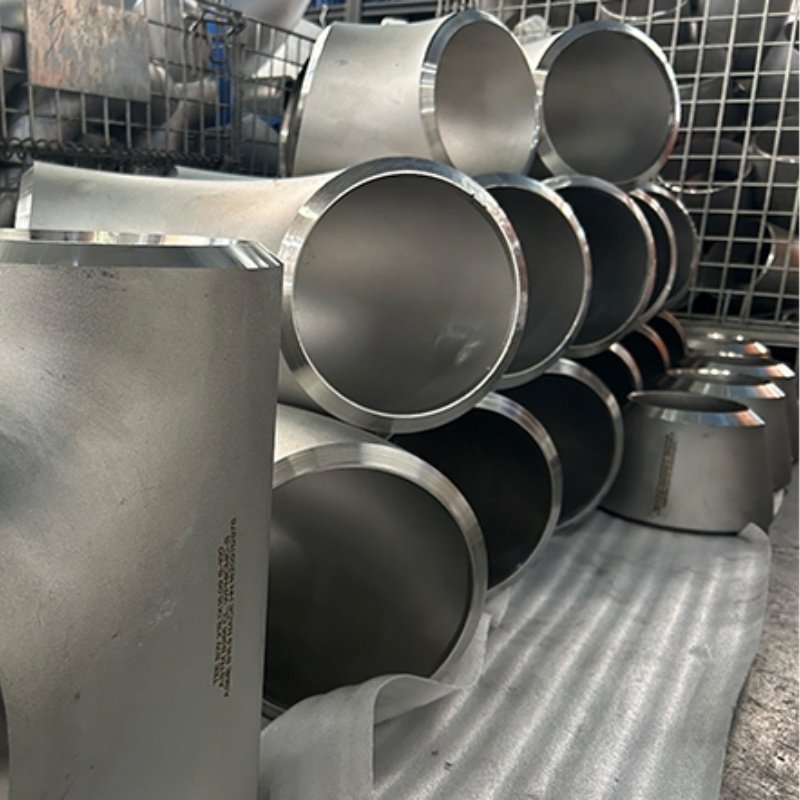
Butt-weld fittings are critical components that achieve piping system connections through butt welding with pipes. Featuring high connection strength, low flow resistance, reliable sealing, and suitability for demanding conditions, they are widely used in petrochemical, offshore engineering, nuclear power energy, pharmaceutical food, and shipbuilding industries. The nickel alloy butt-weld fittings supplied by us are manufactured from high-quality nickel-based alloy seamless pipes or plates through multiple precision processes including pushing/pressing/stamping, solution heat treatment, sizing, machining, and pickling/passivation. Featuring uniform wall thickness, good streamlined shape, dense structure, and excellent corrosion resistance, they are specifically designed for piping systems under high temperature, high pressure, and severe corrosion conditions.
Main Product Types:
Supply Range
Nominal Diameter (DN/NPS): DN15 – DN600 (1/2 inch – 24 inches)
Wall Thickness: SCH 5S, SCH 10S, SCH 40S, SCH 80S, SCH 160, XXS
Forming Process: Seamless Pushing (DN≤600), Plate Forming/Welding (DN>600 or non-standard)
End Type: Bevelled End (standard), Plain End optional
Surface Condition: Pickled, Passivated, Polished optional
Dimensional Inspection
Appearance Inspection
Non-Destructive Testing
Third-Party Inspection Support
We welcome clients to designate international Third-party inspection agencies for pre-shipment inspection, with shipment only after passing inspection.
Nickel alloy pipe systems are governed by two separate families of
standard, and buyers routinely conflate them. The material
is fixed by an ASME Section II specification; the dimensions
are fixed by an ASME B16 series dimensional standard. A fitting can be
perfectly correct on chemistry and still be wrong on centre-to-end.
| Property | Governing standard | What it fixes |
|---|---|---|
| Chemical composition, mechanical properties, heat treatment | ASME Section II material spec (SB-366, SB-564, SB-462) | What the alloy is |
| Centre-to-end, face-to-face, overall length, tolerances | ASME B16.9 (butt weld) / ASME B16.11 (forged socket weld & threaded) | How the part is shaped |
| Weld end bevel and root face | ASME B16.25 | How the joint is prepared |
| Bolting and thread make-up | ASME B18.2.1 / B1.20.1 | How threads are cut and sealed |
| Flange face geometry and rating | ASME B16.5 (up to NPS 24) / ASME B16.47 (NPS 26 and above) | How the flange mates |
ASME SB-366 Scope 1.1 states that wrought welding fittings are those
covered by ASME B16.9, ASME B16.11, MSS SP-43, MSS SP-95 and MSS SP-97. That
cross-reference is the authoritative link between the material specification
and the dimensional standard.
The grades below are those covered by the material specifications we
supply against. Note that not every grade is available in every
form — a grade listed for forgings is not automatically
available as a weld-neck flange, because flange product forms carry their
own material specification.
| Form | Butt weld (B16.9) | Forged SW / threaded (B16.11) | Flange (B16.5 / B16.47) |
|---|---|---|---|
| UNS N06625 (Inconel 625) | SB-366 / SB-564 | SB-564 | SB-564 |
| UNS N06600 (Inconel 600) | SB-366 / SB-564 | SB-564 | SB-564 |
| UNS N04400 (Monel 400) | SB-366 / SB-564 | SB-564 | SB-564 |
| UNS N10276 (Hastelloy C-276) | SB-366 / SB-564 | SB-564 | SB-462 / SB-564 |
| UNS N06022 (Hastelloy C-22) | SB-366 | SB-564 | SB-462 |
| UNS N06200 | SB-366 | SB-564 | SB-462 |
| UNS N08020 / N08031 | SB-366 | SB-564 | SB-462 |
Verified against ASME BPVC Section II: SB-366 (wrought nickel and nickel
alloy fittings), SB-564 (nickel alloy forgings, scope lists N04400, N06600,
N06625, N10276, N06022, N06200, N08020, N08031), SB-462 (forged nickel alloy
pipe flanges, scope lists N10276, N06022, N06200, N08020, N08031).
Precipitation-hardenable grades such as N07718 (Inconel 718) are
not covered by SB-366 or SB-564; they fall under SB-637.
SA-182 is a low-alloy and stainless steel specification and contains no
nickel alloy grades.
For the alloy-specific chemistry and mechanical property tables, see our
grades pages: Inconel 625
butt weld fittings, Monel
400 butt weld fittings,
Hastelloy C-276 butt
weld fittings and
forged nickel
alloy socket weld fittings. For flange standard selection, see
ASME
B16.5 vs B16.47: which flange standard applies.