Address
304 North Cardinal St.
Dorchester Center, MA 02124
Work Hours
Monday to Friday: 7AM - 7PM
Weekend: 10AM - 5PM
Address
304 North Cardinal St.
Dorchester Center, MA 02124
Work Hours
Monday to Friday: 7AM - 7PM
Weekend: 10AM - 5PM

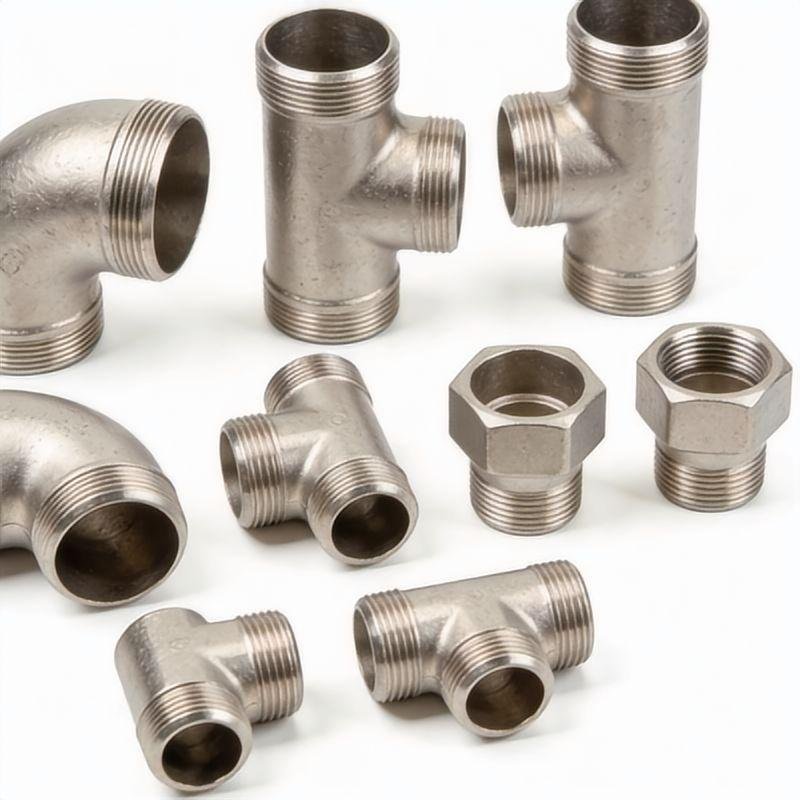
Inconel 625 threaded fittings to ASME B16.11 and SB-564, UNS N06625. NPT threads per ASME B1.20.1, Class 2000/3000/6000. EN 10204 3.1 MTC on request.
Inconel 625 threaded fittings are the small-bore, dismountable end of the Inconel 625 product range. UNS N06625 is a nickel-chromium-molybdenum-columbium alloy whose 8 % molybdenum and 3.6 % niobium give it far more chloride pitting margin than 316L or even standard duplex, while the nickel base keeps it essentially free of chloride stress-corrosion cracking. ASME B16.11 threaded fittings answer a narrow but very specific need: an instrument or impulse line, a chemical injection point or a sampling spur that has to be opened without cutting pipe and welding. The threads are ASME B1.20.1 NPT, the bodies are forged and solution annealed, and the pressure classes are the B16.11 threaded set rather than the flange classes used elsewhere on the site.
This page covers the alloy and the threaded form. For the socket weld form of the same alloy see our Inconel 625 socket weld fittings page, and for the butt weld form see our Inconel 625 butt weld fittings page. The full range of nickel alloy threaded fittings in every grade is on our nickel alloy forged threaded fittings overview.
| Designation | Value |
|---|---|
| UNS number | N06625 |
| Material specification | ASME SB-564 (nickel alloy forgings); ASME SB-366 covers wrought nickel and nickel alloy fittings, and its scope explicitly extends to threaded fittings as covered in ASME B16.11 |
| Dimensional standard | ASME B16.11 (forged fittings, socket-welding and threaded) |
| Thread standard | ASME B1.20.1 NPT |
| Pressure class | Class 2000, 3000 and 6000 (threaded end fittings) |
| Marking | CRNCMC for corrosion-resistant fittings, WPNCMC for pressure fittings, with the class suffix per ASME SB-366 Table 4 |
| Delivery condition | Solution annealed and pickled |
| Element | Composition, % (max unless stated) |
|---|---|
| Nickel | 58.0 min, balance |
| Chromium | 20.0 – 23.0 |
| Molybdenum | 8.0 – 10.0 |
| Columbium (Nb) + tantalum | 3.15 – 4.15 |
| Iron | 5.0 |
| Carbon | 0.10 |
| Manganese | 0.50 |
| Silicon | 0.50 |
| Phosphorus | 0.015 |
| Sulfur | 0.015 |
| Aluminium | 0.40 |
| Titanium | 0.40 |
| Cobalt (if determined) | 1.0 |
Limits as published for UNS N06625 in ASME SB-564 Table 1. The same alloy specified as pipe and tube in ASME SB-444 Table 2 carries identical limits, which is why a 625 fitting and 625 pipe can be welded to one another without a composition check at the joint.
| Condition | Tensile, min ksi (MPa) | Yield (0.2 %), min ksi (MPa) | Elongation, min % |
|---|---|---|---|
| Grade 1, annealed | 120 (827) | 60 (414) | 30 |
| Grade 2, solution annealed | 100 (690) | 40 (276) | 30 |
Room-temperature values from ASME SB-444 Table 1 for UNS N06625. For forgings specifically, ASME SB-564 Table 2 gives 120 (827) / 60 (414) / 30 for annealed material up to 4 in. (102 mm) section thickness, reducing to 110 (758) / 50 (345) / 25 above that thickness. Grade 2, solution annealed, is the condition normally supplied for corrosion service; Grade 1, annealed, is used where higher strength is preferred and the service temperature stays below about 593 °C.
| Item | Requirement |
|---|---|
| Governing dimensional standard | ASME B16.11 |
| Nominal size range covered | NPS 1/8 to NPS 4 (DN 6 to DN 100) |
| End preparation | ASME B1.20.1 NPT female taper thread |
| Pressure classes | Class 2000, Class 3000, Class 6000 for threaded ends |
| Class to pipe wall | Class 2000 and 3000 are used with Schedule 80 / XS wall, Class 6000 with Schedule 160 and heavier wall |
| Common forms | 90° and 45° elbows, tees, crosses, couplings, reducers, caps, plugs, hex heads and bushings |
| Availability beyond the standard range | TBC against the specific enquiry |
The body is forged from nickel alloy bar or forging stock, solution annealed and pickled, then machined and the NPT threads cut and gauged. All forming and machining is completed before the final heat treatment, which is the sequence ASME SB-366 requires of all heat-treated fittings. Grade 1 material is annealed at 1600 °F (871 °C) minimum and Grade 2 material is solution annealed at 2000 °F (1093 °C) minimum, with rapid air or water cooling; ASME SB-366 Table 3 gives the same two conditions for the WP grade. Thread gauging is carried out on the finished fitting with the applicable plug and ring gauges, because a thread that is cut but not gauged is the most common cause of a fitting that will not run tight.
Fittings are supplied solution annealed and pickled, with a machined surface
finish. Each fitting carries the grade, the governing material specification, the
dimensional standard, the nominal size and the heat number, linked to the
EN 10204 certificate issued with the shipment. Export packing is by wooden
crate, steel pallet or case, with plastic end caps and, where required, VCI
protection inside the case. Beveled or plain ends are confirmed with the
order. Delivery schedule, quantity, minimum order quantity and price are
confirmed only against a specific enquiry.
Nickel alloys gall, and that is the whole story on a threaded joint. Nickel-chromium-molybdenum alloys work-harden rapidly as they are tightened, and the two surfaces of the joint then resist each other rather than sliding past. A 625 elbow that has been made up once and then removed and made up again is no longer a fitting you should return to service. Use a thread compound compatible with the service, follow a controlled make-up torque, and treat a threaded nipple that has been tightened and disturbed as a consumable item.
Threaded ends are not radiographable. A full-penetration butt weld can be examined by radiography or ultrasonic testing; an NPT thread has no root fusion to examine. Where a project requires the joint to be proved by examination, a socket weld or butt weld connection is the only answer, and the choice of a threaded fitting is a decision about inspection philosophy as much as about installation convenience.
The class number is a pairing instruction, not a pressure rating. ASME B16.11 Class 2000, 3000 and 6000 describe how the fitting body and the pipe wall work together. A Class 6000 fitting on a Schedule 40 pipe does not raise the system to Class 6000; the pipe wall governs. This is the same reason a Class 3000 socket weld elbow on Schedule 40 pipe is a poor specification: the fitting can hold the pressure while the thinner pipe welded to it becomes the weak point in the line.
Grades are selected by service temperature, not by habit. Grade 1 annealed 625 carries roughly 50 % more yield strength than Grade 2 solution annealed 625, which is useful in a compact instrument manifold. Grade 2 is the condition for anything above about 593 °C, where creep and stress rupture start to matter and the lower strength of the solution annealed condition is offset by its better high-temperature stability.
ASME B16.11 covers NPS 1/8 to NPS 4, which is DN 6 to DN 100. Availability outside that band, and specific wall thicknesses, are confirmed against the enquiry.
ASME B16.11 designates threaded end fittings as Class 2000, Class 3000 and Class 6000. Socket weld ends are designated Class 3000, Class 6000 and Class 9000. The class describes the pairing with the pipe wall rather than a pressure in isolation.
Yes, NPT taper threads to ASME B1.20.1, gauged on the finished fitting. BSP and BSPT threads can be supplied on request where the project specifies them.
The alloy is well suited to H2S-containing chloride service, but because the joint cannot be radiographed and because the hardness limit in sour service has to be stated, the hardness requirement and any supplementary testing must be written on the purchase order rather than assumed.
EN 10204 3.1 is supplied as standard, with 3.2 available on request. Chemical and mechanical results are reported against the heat number stamped on the fitting.
Those are the marking designations ASME SB-366 Table 2 assigns to UNS N06625: CRNCMC for corrosion-resistant fittings and WPNCMC for pressure fittings, with the class suffix added for seamless, welded or welded-and-examined construction.