Address
304 North Cardinal St.
Dorchester Center, MA 02124
Work Hours
Monday to Friday: 7AM - 7PM
Weekend: 10AM - 5PM
Address
304 North Cardinal St.
Dorchester Center, MA 02124
Work Hours
Monday to Friday: 7AM - 7PM
Weekend: 10AM - 5PM

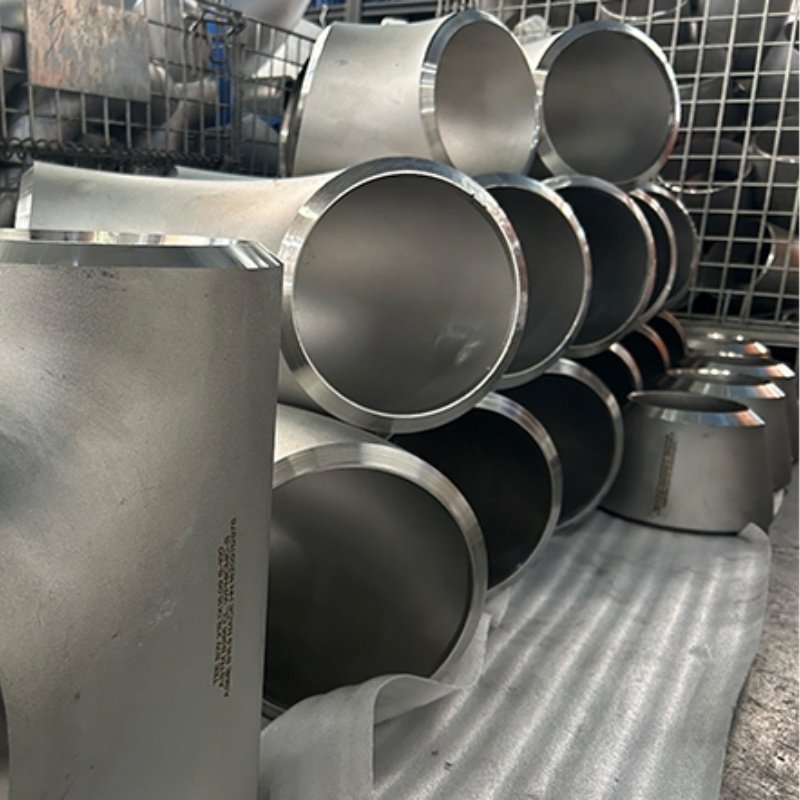
Nickel Alloy 200 and 201 butt weld fittings to ASME B16.9 and SB-564, UNS N02200 and N02201. Annealed, EN 10204 3.1 MTC. Caustic and HF service.
Nickel Alloy 200 and Nickel Alloy 201 butt weld fittings cover the unalloyed end of the nickel alloy family, and they behave nothing like the alloy names beside them. Both grades are 99.0 % nickel minimum with no chromium and no molybdenum, so there is no passive film and no pitting resistance to draw on. What they have instead is the nickel matrix itself: unalloyed nickel is the classic answer for caustic alkalis, for hydrofluoric acid and for chloride service where stress corrosion cracking is the risk. UNS N02200 is the higher carbon grade and UNS N02201 the low carbon grade; the two are supplied to the same dimensional standard and the same dimensional data, and the choice between them is a mechanical-property and forming decision rather than a dimensional one.
As butt weld fittings they carry the same wall as the pipe they are welded to, so the connection is fully welded and fully examinable. For the full range of nickel alloy butt weld forms see our nickel alloy butt weld fittings overview, and for the corresponding pipe see nickel alloy pipe and tube.
| Designation | Value |
|---|---|
| UNS numbers | N02200 (Nickel Alloy 200) and N02201 (Nickel Alloy 201) |
| Material specification | ASME SB-564 (nickel alloy forgings) covers UNS N02200; ASME SB-366 covers wrought nickel and nickel alloy fittings and both grades |
| Dimensional standard | ASME B16.9 (factory-made wrought buttwelding fittings) |
| Heat treatment | Annealed, 1650 – 1700 °F (900 – 928 °C), rapid air or water cooling |
| Marking | CRN / WPN for UNS N02200, CRNL / WPNL for UNS N02201 |
| Delivery condition | Annealed and pickled |
| Element | UNS N02200, % | UNS N02201, % |
|---|---|---|
| Nickel | 99.0 min | 99.0 min |
| Copper | 0.25 max | 0.25 max |
| Iron | 0.40 max | 0.40 max |
| Manganese | 0.35 max | 0.35 max |
| Carbon | 0.15 max | 0.02 max |
| Silicon | 0.35 max | 0.35 max |
| Sulfur | 0.01 max | 0.01 max |
| Chromium, molybdenum, niobium, aluminium, titanium | no requirement | no requirement |
Limits as published for UNS N02200 in ASME SB-564 Table 1, with the low carbon grade UNS N02201 taken from ASME SB-162 Table 2. Nickel is determined arithmetically by difference. The single meaningful difference between the two grades is carbon, and it shows up in the mechanical properties rather than in the corrosion behaviour.
The specification boundary matters here. ASME SB-564 lists UNS N02200 in its scope but not UNS N02201, and ASME SB-366 Table 2 gives the raw material route for each grade separately: N02200 may be made from B160 bar or from B564 forging stock, while N02201 is routed through B160 bar only. A low carbon 201 fitting therefore cannot simply be certified to SB-564, and the UNS number has to appear on the order rather than a trade name.
| Grade and condition | Tensile, min psi (MPa) | Yield (0.2 %), min psi (MPa) | Elongation, min % |
|---|---|---|---|
| UNS N02200, annealed | 55 000 (380) | 15 000 (105) | 40 |
| UNS N02201, annealed | 50 000 (345) | 10 000 (70) | 40 |
UNS N02200 from ASME SB-160 Table 1, corroborated by ASME SB-564 Table 2, which gives 55 (380) / 15 (105) / 40 for annealed UNS N02200 forgings. UNS N02201 from ASME SB-160 Table 1. The low carbon grade is the softer and more ductile of the two: the yield strength falls by a third while elongation is unchanged, which is why 201 is the grade normally chosen where the fitting has to be formed, drawn or expanded after delivery, and 200 is chosen where higher strength in the delivered condition is worth more than formability.
| Item | Requirement |
|---|---|
| Governing dimensional standard | ASME B16.9 |
| Nominal size range covered | NPS 1/2 to NPS 48 (DN 15 to DN 1200) |
| Wall thickness | As the pipe schedule to which the fitting is welded; the fitting wall and the pipe wall are matched, not independently selected |
| End preparation | Bevelled to ASME B16.25, plain ends on request |
| Common forms | 90° and 45° elbows, 180° returns, tees, crosses, concentric and eccentric reducers, caps, couplings and lap joint stub ends |
| Corrosion-resistant fittings note | ASME B16.9 states that it does not cover low pressure corrosion resistant buttwelding fittings, and points to MSS SP-43 for that case; confirm the governing dimensional standard for the specific line |
| Availability beyond the standard range | TBC against the specific enquiry |
Butt weld fittings in these grades are produced either by forging from bar or forging stock and machining the bore, or by hot forming from seamless pipe. Either way the body is annealed at 1650 to 1700 °F (900 to 928 °C) and rapidly cooled in air or water, which is the condition ASME SB-366 Table 3 specifies for both N02200 and N02201. Annealing leaves the material soft and fully ductile, and with no chromium in the chemistry there is no passivation step to perform afterwards — the surface is pickled to remove the heat tint and nothing further is expected of it.
Fittings are supplied solution annealed and pickled, with a machined surface
finish. Each fitting carries the grade, the governing material specification, the
dimensional standard, the nominal size and the heat number, linked to the
EN 10204 certificate issued with the shipment. Export packing is by wooden
crate, steel pallet or case, with plastic end caps and, where required, VCI
protection inside the case. Beveled or plain ends are confirmed with the
order. Delivery schedule, quantity, minimum order quantity and price are
confirmed only against a specific enquiry.
There is no passive film to rely on. In a stainless or duplex grade, chromium forms a self-healing oxide layer that does most of the corrosion protection and that can be restored by pickling. Unalloyed nickel has no chromium at all, so all of its resistance comes from the nickel matrix itself. That is an advantage in caustic, where nickel is outstanding, and a limitation in chloride pitting, where a 6 % molybdenum super austenitic or a duplex grade will outlast it. Matching the grade to the service is therefore less about brand name and more about what the metal is actually being asked to survive.
200 versus 201 is a mechanical decision, not a chemical one. Both grades are 99.0 % nickel with the same copper, iron, manganese, silicon and sulfur limits and effectively the same corrosion behaviour. What separates them is carbon: 0.15 % maximum against 0.02 % maximum. The higher carbon gives 200 about 50 % more yield strength in the annealed condition, while the low carbon of 201 gives it better ductility, better formability and a weld heat-affected zone that resists hot cracking. Where the fitting is subsequently expanded, spun or drawn, 201 is the grade that will survive the operation; where the component is machined from solid and loaded in service, 200 does more work.
Pickling is a controlled step, not a formality. Unalloyed nickel is soft and prone to scratching, and the machined surface of a forged fitting is easily damaged in handling. The pickling bath must be controlled so that the surface is not attacked, and the fittings should be protected in packing rather than left exposed, because a scratched or contaminated surface on a corrosion-alloy fitting is a site for pitting initiation that the material cannot resist.
Carbon. UNS N02200 allows 0.15 % carbon maximum and UNS N02201 allows 0.02 % maximum. Nickel 200 is the stronger grade in the annealed condition; 201 is the more ductile and more formable grade with better resistance to hot cracking when welded.
ASME SB-564 covers forgings in UNS N02200, and ASME SB-366 covers wrought nickel and nickel alloy fittings in both grades. Low carbon UNS N02201 is not within the scope of SB-564, so write the UNS number on the order.
ASME B16.9 covers NPS 1/2 to NPS 48, DN 15 to DN 1200. The fitting wall follows the pipe schedule it will be welded to. Specific availability is confirmed against the enquiry.
Yes. Unalloyed nickel is a standard material for caustic alkalis at elevated temperature and is essentially immune to chloride stress-corrosion cracking. It has no chromium, so it is not a pitting-resistant grade and should not be specified for chloride pitting duty.
Yes. Annealed at 1650 to 1700 °F (900 to 928 °C) with rapid air or water cooling, per ASME SB-366 Table 3, and pickled.
Yes. The butt weld joint is fully welded and can be examined by radiography or ultrasonic testing as required, which is one of the reasons a butt weld fitting is chosen in place of a threaded one on critical service.