Address
304 North Cardinal St.
Dorchester Center, MA 02124
Work Hours
Monday to Friday: 7AM - 7PM
Weekend: 10AM - 5PM
Address
304 North Cardinal St.
Dorchester Center, MA 02124
Work Hours
Monday to Friday: 7AM - 7PM
Weekend: 10AM - 5PM

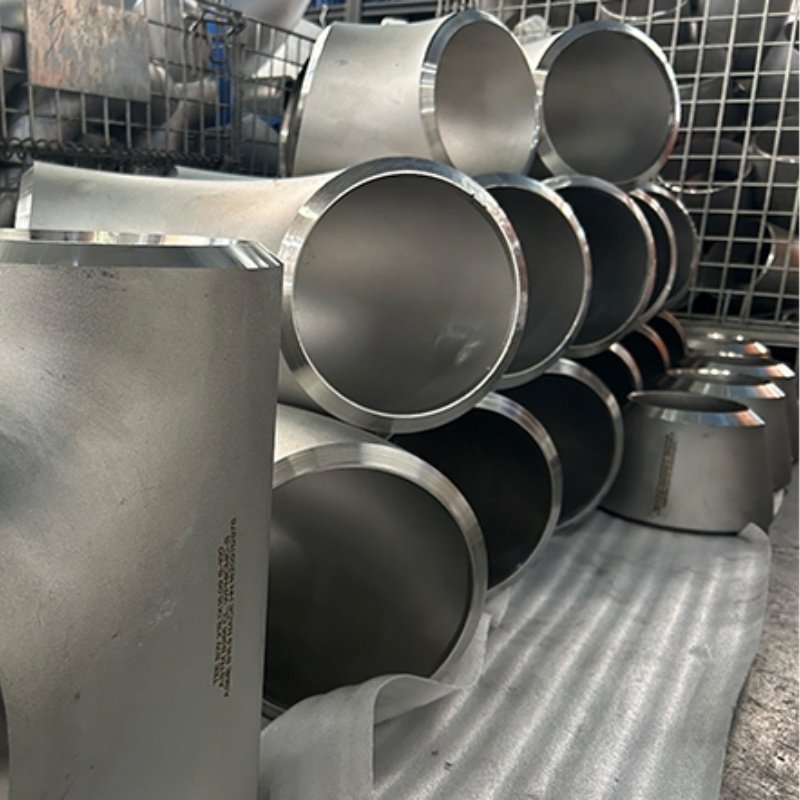
Duplex 2205 butt weld fittings to ASME B16.9, SA-182 F 51 / F 60 and SA-815. Solution annealed and quenched, UNS S31803 and S32205. EN 10204 3.1 MTC.
Duplex 2205 butt weld fittings are the stainless answer to the service that outgrows 316L: chloride-bearing process lines, produced water, seawater injection, pulp and paper bleaching, chemical tank farms and offshore utility piping. The name 2205 covers two forging grades, F 51 in UNS S31803 and F 60 in UNS S32205, which differ in chromium, molybdenum and nitrogen and, as a direct consequence, in the minimum yield strength the fitting will carry. Both are supplied in the solution annealed and quenched condition, and the quench is not a detail to be left to the fabricator, because it is the quench that holds the microstructure in balance.
As butt weld fittings they carry the same wall as the pipe and can be radiographed or ultrasonically examined as a full-penetration joint, which makes them the default choice on any line where the joint has to be proved. For the full range of stainless and nickel alloy butt weld forms see our nickel alloy butt weld fittings overview. The grade selection map, showing which forging and wrought grade belongs to each UNS number, is on our duplex stainless steel fittings page on the pipe and tube site.
| Designation | Value |
|---|---|
| Forging grades | ASME SA-182 F 51 (UNS S31803) and F 60 (UNS S32205) |
| Wrought fitting grades | ASME SA-815 WPS31803 / CRS31803 and WPS32205 / CRS32205 |
| Dimensional standard | ASME B16.9 (factory-made wrought buttwelding fittings) |
| Heat treatment | Solution treated and quenched; F 51 and F 60 at 1870 °F (1020 °C) minimum, liquid quench |
| Preheat and post-weld heat treatment | Neither required for the ferritic-austenitic grades in ASME SA-182 |
| Weld metal | Deposited weld to conform to the base metal composition, or nominal 22 % Cr, 9 % Ni, 3 % Mo for UNS S31803 |
| Delivery condition | Solution treated, quenched and pickled |
| Element | F 51 (S31803), % | F 60 (S32205), % |
|---|---|---|
| Chromium | 21.0 – 23.0 | 22.0 – 23.0 |
| Nickel | 4.5 – 6.5 | 4.5 – 6.5 |
| Molybdenum | 2.5 – 3.5 | 3.0 – 3.5 |
| Nitrogen | 0.08 – 0.20 | 0.14 – 0.20 |
| Carbon | 0.030 | 0.030 |
| Manganese | 2.00 | 2.00 |
| Silicon | 1.00 | 1.00 |
| Phosphorus | 0.030 | 0.030 |
| Sulfur | 0.020 | 0.020 |
Composition as published in ASME SA-182 Table 2 for F 51 and F 60. The wrought grades in ASME SA-815 carry the same analyses for the equivalent UNS numbers. Nitrogen is the element that most separates the two grades on paper and least in the order book, because it is not always called out when 2205 is specified informally — which is exactly why the forging grade should be written on the order.
| Grade | Tensile, min ksi (MPa) | Yield (0.2 %), min ksi (MPa) | Elongation, min % | Reduction of area, min % |
|---|---|---|---|---|
| F 51 (S31803) | 90 (620) | 65 (450) | 25 | 45 |
| F 60 (S32205) | 95 (655) | 70 (485) | 25 | 45 |
As published in ASME SA-182 Table 3. The minimum yield strength of F 60 was increased in this edition of SA-182, so the two 2205 grades are no longer interchangeable on strength even though the trade name is the same. A pressure design that assumed F 51 strength on an F 60 fitting is not a conservative assumption, because the certificate will show the higher strength grade and the thinner wall may have been chosen against the F 51 figure. This is the reason to name the grade and not the trade name.
| Item | Requirement |
|---|---|
| Governing dimensional standard | ASME B16.9 |
| Nominal size range covered | NPS 1/2 to NPS 48 (DN 15 to DN 1200) |
| Wall thickness | As the pipe schedule to which the fitting is welded |
| End preparation | Bevelled to ASME B16.25, plain ends on request |
| Common forms | 90° and 45° elbows, 180° returns, tees, crosses, concentric and eccentric reducers, caps, couplings and lap joint stub ends |
| Mating flange | ASME B16.5 up to NPS 24, ASME B16.47 for the larger sizes; duplex flanges are supplied in the matching forging grade |
| Availability beyond the standard range | TBC against the specific enquiry |
Forged fittings are hot worked, then solution treated and quenched: ASME SA-182 Table 1 requires F 51 and F 60 to be solution treated and quenched at 1870 °F (1020 °C) minimum with liquid quenching, and SA-182 also permits a ferritic-austenitic forging to be solution annealed without cooling below 1000 °F by being re-heated to the solution annealing temperature, held long enough to dissolve the phases and precipitates that would reduce corrosion resistance or mechanical properties, and quenched in accordance with the table. Wrought fitting grades to ASME SA-815 use the same sequence with their own temperature bands: 1870 to 2010 °F (1020 to 1100 °C) for UNS S31803 and UNS S32205, with no tempering required. The quench rate through the intermediate range is the single most important variable in the whole process, and it is the reason the heat treatment is written into the specification rather than left to the works.
Fittings are supplied solution annealed and pickled, with a machined surface
finish. Each fitting carries the grade, the governing material specification, the
dimensional standard, the nominal size and the heat number, linked to the
EN 10204 certificate issued with the shipment. Export packing is by wooden
crate, steel pallet or case, with plastic end caps and, where required, VCI
protection inside the case. Beveled or plain ends are confirmed with the
order. Delivery schedule, quantity, minimum order quantity and price are
confirmed only against a specific enquiry.
Two phases, and the balance between them is the whole material. A duplex grade is roughly half austenite and half ferrite. The austenite phase brings the chloride resistance, because it contains the chromium and the molybdenum and because austenite does not suffer the chloride stress corrosion cracking that ferritic or martensitic stainless does. The ferrite phase brings roughly twice the strength of austenitic stainless at the same section size. Neither phase alone would be worth specifying; the value is in the combination, and that is why the phase balance has to be held and verified rather than assumed.
Quench speed, not furnace temperature, protects the properties. Slow cooling through the intermediate range lets sigma phase, chi phase and chromium nitrides precipitate in the ferrite, and the result is a loss of both impact toughness and corrosion resistance. A duplex fitting can therefore be chemically correct and still fail its corrosion test, purely because the quench was not fast enough for the section thickness involved. This is also the reason the SA-182 alternative heat treatment route exists, allowing the forging to be re-heated and re-quenched when the first cooling was not adequate.
Weld metal has to be qualified, not merely matched. ASME SA-815 requires the deposited weld to conform to the same composition requirements as the base metal, and for UNS S31803 it permits a nominal 22 % Cr, 9 % Ni, 3 % Mo weld metal as the alternative. The filler qualification is therefore part of the fabrication specification, not a consumable choice, and heat input has to be controlled to protect the heat-affected zone of the joint.
Temperature and chloride are a pair, not a single number. The resistance to chloride stress-corrosion cracking that duplex grades are chosen for holds while the metal is cold enough, and the widely used stainless alternatives lose that advantage as the temperature climbs. The corrosion data, the phase balance requirement and the service temperature have to be assessed together; a duplex fitting selected on room-temperature data and then used in a hot chloride line is a common way to end up with a grade that was never qualified for the duty.
Both are 2205. F 51 is UNS S31803 with 21.0 to 23.0 % chromium and 2.5 to 3.5 % molybdenum; F 60 is UNS S32205 with 22.0 to 23.0 % chromium, 3.0 to 3.5 % molybdenum and higher nitrogen. The minimum yield strength differs, 65 ksi against 70 ksi, so write the forging grade on the order.
Solution treated and quenched at 1870 °F (1020 °C) minimum with liquid quenching for F 51 and F 60, per ASME SA-182 Table 1. Wrought grades to SA-815 use 1870 to 2010 °F with no tempering required.
No. ASME SA-182 requires neither preheat nor post-weld heat treatment for the ferritic-austenitic grades. Control of heat input and the filler qualification protect the joint instead.
ASME SA-815 requires the deposited weld to conform to the base metal composition, and for UNS S31803 it permits nominal 22 % Cr, 9 % Ni, 3 % Mo weld metal as the alternative. Filler selection belongs in the fabrication specification.
Yes. The butt weld joint is full penetration and can be examined by radiography or ultrasonic testing, which is one of the main reasons duplex butt weld fittings are chosen over a threaded connection on critical lines.
ASME B16.9 covers NPS 1/2 to NPS 48, DN 15 to DN 1200, with the fitting wall following the pipe schedule. Specific availability is confirmed against the enquiry.