Address
304 North Cardinal St.
Dorchester Center, MA 02124
Work Hours
Monday to Friday: 7AM - 7PM
Weekend: 10AM - 5PM
Address
304 North Cardinal St.
Dorchester Center, MA 02124
Work Hours
Monday to Friday: 7AM - 7PM
Weekend: 10AM - 5PM

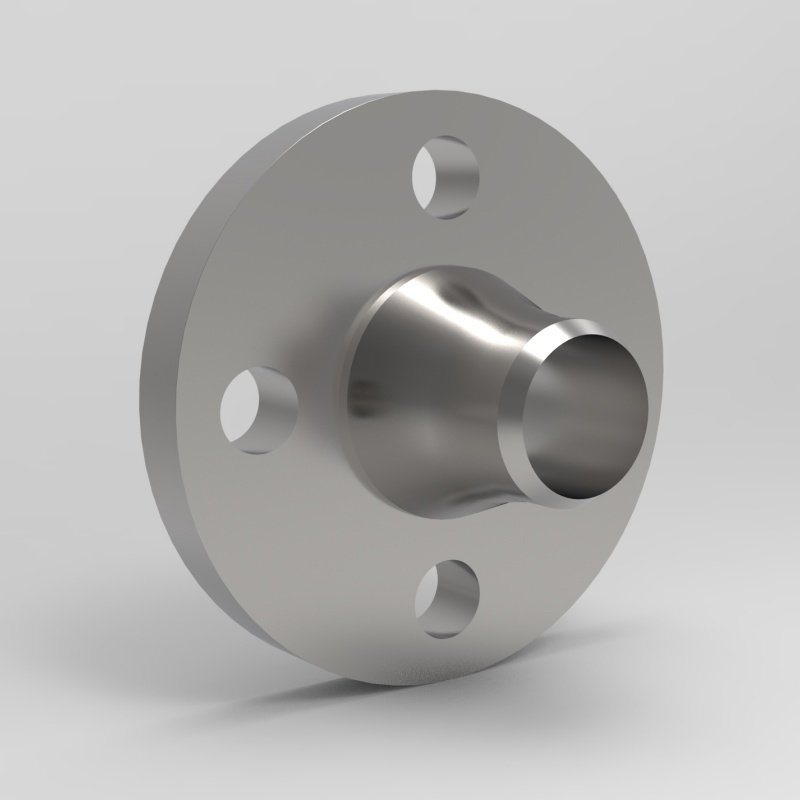
Inconel 625 forged pipe flanges to ASME SB-564 and B16.5, UNS N06625. Weld neck, slip-on, socket weld, threaded and blind. EN 10204 3.1 MTC.
Inconel 625 forged pipe flanges are the raised-face connection for sour, chloride-bearing and seawater piping where a 316L flange would sweep. UNS N06625 is a nickel-chromium-molybdenum-columbium alloy whose 8 % to 10 % molybdenum and 3.15 % to 4.15 % columbium give it far more chloride pitting margin than 316L or even standard duplex, while the nickel base keeps it essentially free of chloride stress-corrosion cracking. ASME B16.5 gives the flange its geometry and its pressure class; ASME SB-564 gives the forging its chemistry, its heat treatment and its certification. Both numbers belong on the same line of the purchase order, and if you only write one of them you have not specified a flange.
For the butt weld and socket weld fitting forms of the same alloy see our Inconel 625 butt weld fittings and Inconel 625 socket weld fittings pages. For the threaded form see Inconel 625 threaded fittings.
| Designation | Value |
|---|---|
| UNS number | N06625 |
| Material specification | ASME SB-564 (nickel alloy forgings). ASME B16.5 Table 1A lists the grade in material group 3.8 as B 564 Gr. N06625, with B 443 Gr. N06625 for plate |
| Dimensional standard | ASME B16.5 (NPS 1/2 to NPS 24); ASME B16.47 (NPS 26 to NPS 60) |
| Rating table | ASME B16.5 Table 2-3.8, material group 3.8 |
| Material group | 3.8, nominal designation 60Ni–22Cr–9Mo–3.5Cb |
| Pressure class | Class 150, 300, 600, 900, 1500 and 2500 (Class 2500 to NPS 12 only) |
| Delivery condition | Annealed, per ASME SB-564 Table 2 |
| Marking | Per ASME B16.5 paragraph 4.2.3 and 4.2.8; nickel alloy forgings stamped in accordance with MSS SP-25 |
ASME B16.5 covers pressure-temperature ratings, materials, dimensions, tolerances, marking, testing and the method of designating openings for pipe flanges and flanged fittings in sizes NPS 1/2 through NPS 24, with rating class designations 150, 300, 400, 600, 900, 1500 and 2500, and Class 2500 applying to NPS 1/2 through NPS 12. For NPS 26 and larger ASME B16.47 takes over, covering welding neck and blind flanges in classes 75, 150, 300, 400, 600 and 900, in two dimensional series that are not interchangeable: Series A follows the former MSS SP-44 practice and Series B follows the former API 605 practice.
Two dimensional points decide whether a flange will actually mate. The first is the raised face height: ASME B16.5 paragraph 6.4.1 specifies that Classes 150 and 300 pipe flanges are regularly furnished with a 2 mm (0.06 in.) raised face and that Classes 400, 600, 900, 1500 and 2500 are regularly furnished with a 7 mm (0.25 in.) raised face, in each case in addition to the minimum flange thickness tf. A Class 150 flange therefore does not seat against a Class 600 flange without a gasket that tolerates the height difference. The second is the bore: ASME B16.5 note (7) to the dimension tables ties the bore to the inside diameter of B36.10M standard wall pipe, with Schedule 40 wall in NPS 10 and smaller, and paragraph 6.3.2 allows a raised face to be removed to convert a raised face flange to a flat face flange provided the required tf dimension is maintained.
Full dimension tables for Class 150 (Table F8), Class 300 (Table F11), Class 600 (Table F16) and Class 900 (Table F18) are published separately on this site in ASME B16.5 flange dimensions: Class 150, 300, 600 and 900, and the boundary between the two flange standards is covered in ASME B16.5 or B16.47: which flange standard applies at what size.
The flange types supplied for this grade are welding neck, slip-on, socket weld, threaded, lap joint and blind. Welding neck is the normal choice for butt-welded sour and seawater piping because the long hub spreads the bolt load into the pipe wall and keeps the gasket joint concentric under thermal cycling; slip-on and threaded flanges are used where the joint has to be opened for inspection without cutting the pipe. Socket weld flanges are produced to NPS 3 and smaller only. In a lined or clad line, the flange is usually the one component left bare, so it carries the full corrosion allowance for the joint on its own.
| Element | Composition, % (max unless stated) |
|---|---|
| Nickel | 58.0 min, determined by difference |
| Chromium | 20.0 – 23.0 |
| Molybdenum | 8.0 – 10.0 |
| Columbium (Nb) + tantalum | 3.15 – 4.15 |
| Iron | 5.0 |
| Carbon | 0.10 |
| Manganese | 0.50 |
| Silicon | 0.50 |
| Phosphorus | 0.015 |
| Sulfur | 0.015 |
| Aluminium | 0.40 |
| Titanium | 0.40 |
| Cobalt, vanadium, tungsten | not required by ASME SB-564 Table 1 (no requirement where an ellipsis appears) |
Source: ASME SB-564 Table 1, chemical requirements. Where the specification shows an ellipsis there is no requirement and the element need neither be analysed for nor reported. Nickel is determined arithmetically by difference, so the certificate reports the analysis rather than the balance. The 3.15 % to 4.15 % columbium-plus-tantalum figure is the columbium addition that gives Inconel 625 its strength in the annealed condition, and it is also the reason the alloy is not a drop-in substitute for 718 in high-temperature service.
| Property | Requirement |
|---|---|
| Tensile strength, min | 120 ksi (827 MPa) up to 4 in. (102 mm) thick; 110 ksi (758 MPa) over 4 in. (102 mm) to 10 in. (254 mm) |
| Yield strength, 0.2 % offset, min | 60 ksi (414 MPa) up to 4 in. (102 mm); 50 ksi (345 MPa) over 4 in. (102 mm) to 10 in. (254 mm) |
| Elongation in 2 in. or 50 mm, min | 30 % up to 4 in. (102 mm); 25 % over 4 in. (102 mm) to 10 in. (254 mm) |
| Condition | Annealed |
Source: ASME SB-564 Table 2, mechanical property requirements, nickel-chromium-molybdenum-columbium alloy UNS N06625. Note that ASME B16.5 note (3) to Table 2-3.8 requires annealed material only, and note (4) states that the alloy is not to be used over 645 °C and that alloy N06625 in the annealed condition is subject to severe loss of impact strength at room temperatures after exposure in the range of 538 °C to 760 °C. That is a service limitation on the flange, not on the pipe, and it applies whether the flange is welded in or supplied as a loose item.
| Temperature, °C | Class 150 | Class 300 | Class 400 | Class 600 | Class 900 | Class 1500 | Class 2500 |
|---|---|---|---|---|---|---|---|
| −29 to 38 | 20.0 | 51.7 | 68.9 | 103.4 | 155.1 | 258.6 | 430.9 |
| 50 | 19.5 | 51.7 | 68.9 | 103.4 | 155.1 | 258.6 | 430.9 |
| 100 | 17.7 | 51.5 | 68.7 | 103.0 | 154.6 | 257.6 | 429.4 |
| 150 | 15.8 | 50.3 | 66.8 | 100.3 | 150.6 | 250.8 | 418.2 |
| 200 | 13.8 | 48.3 | 64.5 | 96.7 | 145.0 | 241.7 | 402.8 |
| 250 | 12.1 | 46.3 | 61.7 | 92.7 | 139.0 | 231.8 | 386.2 |
| 300 | 10.2 | 42.9 | 57.0 | 85.7 | 128.6 | 214.4 | 357.1 |
Source: ASME B16.5 Table 2-3.8, pressure-temperature ratings for group 3.8 materials, expressed in bar. The same table governs UNS N10276, UNS N06625, UNS N08825, UNS N06022 and UNS N06200, because these grades are grouped by their behaviour rather than by alloy family. Intermediate temperatures may be interpolated linearly between tabulated values. Ratings shown are for the annealed condition only, as required by note (3).
Flanges are produced from forged billet by closed-die or open-die forging, with the flow lines oriented to resist the stresses expected in service, then solution annealed and rapidly cooled. ASME SB-564 requires the material to be furnished annealed, and B16.5 note (3) confirms that only annealed material may be used for the pressure ratings in Table 2-3.8. Heat treatment may be performed before machining. After forging, the flange is machined, the bolt holes are drilled and the sealing face is machined to the finish required by the gasket in use.
Welding a flange into the line requires a qualified procedure in accordance with Section IX of the ASME Boiler and Pressure Vessel Code, and the filler metal must match the base metal in columbium and molybdenum content. Because N06625 is a solid-solution alloy rather than a precipitation-hardening one, there is no post-weld heat treatment step and no age-hardening cycle to specify; the strength is in the annealed condition as delivered. The heat-affected zone of a properly welded 625 joint retains the corrosion resistance of the parent metal, which is the reason this alloy is chosen for wet-process piping in preference to a coated alternative.
Supplementary testing on this grade is supplied when it is named on the order rather than assumed: hardness testing, charpy impact testing, intergranular corrosion testing to ASTM G28, ultrasonic or eddy current examination, positive material identification and liquid penetrant examination. NACE MR0175 / ISO 15156 documentation is added where the flange is destined for sour service. The impact testing point is worth raising early for this grade, because ASME B16.5 note (4) warns that annealed UNS N06625 loses impact strength at room temperature after exposure between 538 °C and 760 °C; if the line sees that temperature band, the flange should be qualified against the condition it will actually be in rather than against the as-delivered condition.
Each flange is marked with the material grade and specification, the nominal
size, the pressure class and the heat number. The rating designation number
corresponding to the pressure rating class is applied to the flange in accordance
with ASME B16.5. Where the flange is made from a material that meets more than one
specification or grade, the marking procedure of ASME B16.5 for multiple material
marking is followed. Nickel alloy forgings are stamped in accordance with MSS SP-25
in a position that does not impair the usefulness of the forging. B16.5 also
permits the manufacturer to supplement the mandatory material indications with a
trade designation, provided confusion of symbols is avoided.
Flanges are supplied in the annealed condition, pickled, with a machined sealing
face. Each flange carries the grade, the governing material specification, the
dimensional standard, the nominal size, the pressure class and the heat number,
linked to the EN 10204 certificate issued with the shipment. Export packing is by
wooden crate, steel pallet or case, with plastic end caps and, where required, VCI
protection inside the case. Flange facings are protected individually so that the
sealing surface is not marked in transit. Delivery schedule, quantity, minimum
order quantity and price are confirmed only against a specific enquiry.
Inconel 625 flanges are specified wherever chlorides, sour service and temperature combine against a 316L flange. Typical duties are offshore produced-water and seawater injection manifolds, where the flange is the weakest corrosion point in the branch; sour gas gathering and processing piping under NACE MR0175 / ISO 15156; chemical injection and acid transfer lines; pulp and paper bleaching equipment; pharmaceutical and fine chemical processing; and seawater lift, firewater and cooling systems. They are also used in nuclear steam generator and auxiliary piping and in the primary and secondary circuits of pressurised water reactors.
Why the flange grade is written separately from the pipe grade. ASME SB-564 covers nickel alloy forgings and lists UNS N06625 in its scope, so the forging has its own chemistry, its own heat-treatment condition and its own mechanical-property table with a thickness split at 4 in. The pipe it is welded to may be UNS N06625 to ASME SB-444, which is a different document with a different set of tests. Writing “Inconel 625” on the order leaves it open to a supplier to supply the pipe to one standard and the flange to the other, and the two do not have identical requirements. Write the specification numbers, not the trade name.
The columbium is both the strength and the limit. The 3.15 % to 4.15 % columbium in ASME SB-564 Table 1 is what puts the annealed tensile strength at 120 ksi (827 MPa) for sections up to 4 in. thick. It is also why the same table shows the yield dropping to 50 ksi (345 MPa) for the heavier section above 4 in.: the thicker the forging, the less of the section is fine-grained columbium-carbide strengthened material. B16.5 note (4) then closes the temperature door at 645 °C and warns of the impact-strength loss after exposure between 538 °C and 760 °C. That warning is worth reading twice, because the exposure can be thermal cycling in the line rather than a single hot service, and the consequence is a brittle flange at room temperature in a joint that is otherwise fully qualified.
Class 150 is not a pressure, it is a material grouping. ASME B16.5 Table 1A places UNS N06625 in material group 3.8 with UNS N10276 and several others, and the pressure-temperature table for that group is Table 2-3.8. A Class 150 Inconel 625 flange is therefore rated at 20.0 bar at ambient against the same 19.0 bar Class 150 group 2.2 stainless steel, but the two are not interchangeable in a joint and the ratings fall away at different rates with temperature. A Class 150 625 flange is not a Class 150 316L flange with more margin; it is a different material group sharing a class designation, and the flange that limits the joint is the one with the lower tabulated rating at the actual service temperature.
ASME SB-564 covers the forgings and ASME B16.5 covers the dimensions, pressure classes and marking for NPS 1/2 to NPS 24. Both numbers should appear on the purchase order. For NPS 26 and above, ASME B16.47 replaces B16.5 for the dimensions.
Welding neck, slip-on, socket weld, threaded, lap joint and blind. ASME B16.5 covers socket welding flanges to NPS 3 only. Welding neck is the usual choice for butt-welded piping because the long hub spreads the bolt load into the pipe wall.
At ambient temperature the ASME B16.5 Table 2-3.8 rating for material group 3.8 is 20.0 bar at Class 150, 51.7 bar at Class 300, 103.4 bar at Class 600 and 155.1 bar at Class 900. Ratings fall with temperature, so the rating at the actual service temperature is the one that applies.
No. Inconel 625 is a solid-solution alloy, so there is no precipitation hardening cycle and no post-weld heat treatment step. The procedure is qualified to ASME Section IX with filler metal matching the base metal in columbium and molybdenum.
Classes 150 and 300 are regularly furnished with a 2 mm (0.06 in.) raised face and Classes 600 and 900 with a 7 mm (0.25 in.) raised face, in each case in addition to the minimum flange thickness tf, per ASME B16.5 paragraph 6.4.1. The height has to match the mating flange.
Yes. ASME B16.5 note (4) states that alloy N06625 is not to be used over 645 °C, and that in the annealed condition the alloy suffers severe loss of impact strength at room temperature after exposure between 538 °C and 760 °C.