Address
304 North Cardinal St.
Dorchester Center, MA 02124
Work Hours
Monday to Friday: 7AM - 7PM
Weekend: 10AM - 5PM
Address
304 North Cardinal St.
Dorchester Center, MA 02124
Work Hours
Monday to Friday: 7AM - 7PM
Weekend: 10AM - 5PM

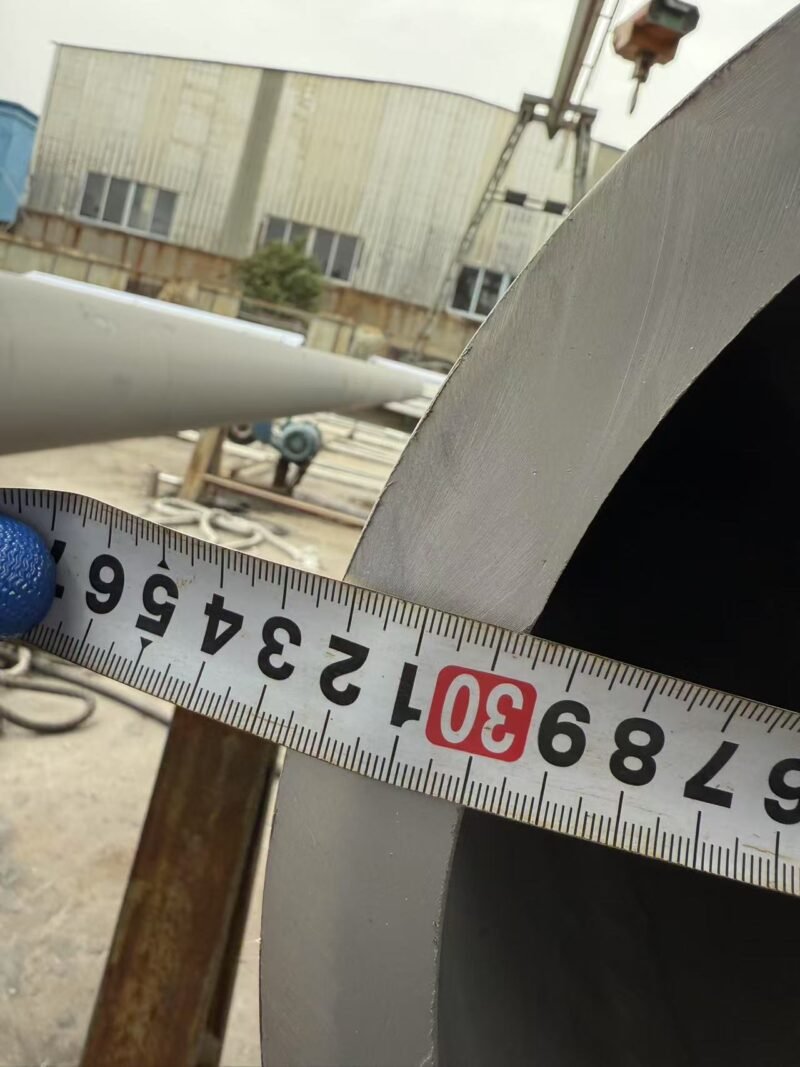
ASME SB-861 covers 34 grades of titanium and titanium alloy seamless pipe,
and ASME SB-862 covers the welded equivalent. Between them they are the
reference specifications for anyone buying titanium pipe for corrosion service
rather than for a general structural duty.
The grades that matter commercially for chemical and marine service are the
commercially pure Grade 2 and the 6Al-4V Grade 5, together with the palladium
stabilised grades Grade 7 and Grade 16 and the higher-strength Grade 23 and
Grade 24. Those six designations appear in the tables below with the
composition limits and mechanical properties as written in ASME SB-348.
| Grade | UNS | Al, wt pct | V, wt pct | Fe, max, wt pct | Tensile, min, ksi [MPa] | Yield, min, ksi [MPa] |
|---|---|---|---|---|---|---|
| Grade 2 | R50400 | – | – | 0.30 | 50 [345] | 40 [275] |
| Grade 5 | R56400 | 5.5 – 6.75 | 3.5 – 4.5 | 0.40 | 130 [895] | 120 [828] |
| Grade 7 | R52400 | – | – | 0.30 | 50 [345] | 40 [275] |
| Grade 9 | R56320 | 2.5 – 3.5 | 2.0 – 3.0 | 0.25 | 90 [620] | 70 [483] |
| Grade 23 | R56407 | 5.5 – 6.5 | 3.5 – 4.5 | 0.25 | – | – |
| Grade 24 | R56405 | 5.5 – 6.75 | 3.5 – 4.5 | 0.40 | – | – |
Grades 23 and 24 are the higher-strength, lower-oxygen variants of the
6Al-4V family. SB-348 Table 2 lists tensile and yield separately for these
grades depending on product section; the applicable row has to be selected
against the section thickness being ordered, so for a specific diameter we
confirm the governing row before the order is accepted.
Grade 7 (R52400) adds 0.12 to 0.25 percent palladium to commercially pure
titanium. Grade 16 (R52402) is a similar palladium addition with a higher
tensile floor. Palladium improves resistance to hydrogen absorption and
reduces the risk of hydrogen embrittlement in acid or sour aqueous service,
which is why these grades appear in offshore and hydroprocessing chloride
systems rather than in general chemical plant.
ASME SB-861 and SB-862 both reference ANSI/ASME B36.19M for the schedule
S designations and B36.10 for the non-S schedules. Outside diameter runs
from NPS 1/8 inch (10.29 mm) upward, and wall thickness is offered across the
5SA, 5A, 10SA, 10A, 40S, 40, 80S and 80 schedule series as standard.
Titanium pipe is also frequently supplied in coil form for heat exchanger
bundles, where the wall is drawn down cold.
| Product form | Specification | Grades |
|---|---|---|
| Seamless pipe | ASME SB-861 / ASTM B861 | 34 grades including Gr 2, 5, 7, 9, 16, 23, 24 |
| Welded pipe | ASME SB-862 / ASTM B862 | 33 grades including Gr 2, 5, 7, 9, 16, 23, 24 |
| Butt weld fittings | ASME SB-363 / ASTM B363 | Grade 2, Grade 5 and higher grades |
| Bar and billet | ASME SB-348 / ASTM B348 | Grade 2, Grade 5 |
| Plate, sheet and strip | ASME SB-265 | 40 grades including Gr 2, 5, 7, 9, 16, 23, 24 |

EN 10204 3.1 certification is supplied with every heat, referencing the
SB-861 or SB-862 specification, the grade and the UNS number. Hydrostatic
testing can be performed on the pipe and is reported on the test record.
Flatness, straightness and ovality are held to the dimensional tables of the
relevant specification, and for thin wall pipe we note ovality explicitly
because thin wall material develops significant out-of-roundness during final
annealing.
Titanium is packed in a way that prevents iron pickup. Contact with carbon
steel storage or a dirty forklift during handling will leave iron imprints
that later become rust streaks and, in service, corrosion initiation points.
Every order ships with the mill protective film or edge protection intact,
and our packing list identifies the bundle for traceability.
Send grade, nominal size, schedule or wall thickness, length, quantity and
the certificate standard required. For heat exchanger bundles, state whether
the tube is to be coiled or straight, the minimum wall and any eddy current
or hydrostatic test requirement. Third party inspection and specific
reversible certificate can be arranged on request. A related product worth
reviewing alongside this grade list is our
titanium Grade 2 and Grade 5 butt weld fittings,
which cover the same alloy in fitting form.
Also see nickel alloy round pipe and tube
for the nickel base alternative, the
nickel alloy pipe and tube
category, the
seamless pipe manufacturing guide
for how the process differs by material, and the
service condition selection
reference for matching an alloy to an actual duty.
ASME SB-861 sets titanium pipe on a different proof-test basis again. Clause 16.1 requires that each length of pipe withstand, without showing bulges, leaks or other defects, an internal hydrostatic pressure that will produce in the pipe wall a stress of 50 % of the minimum specified yield strength at room temperature, determined by the equation P = SEt/(Ro − 0.4t), with S the allowable fiber stress of one-half the minimum yield strength, t the wall thickness, Ro the outside tube radius and E = 1.0 for seamless pipe.
Clause 16.2 then puts a ceiling on it: the maximum hydrostatic test pressure shall not exceed 2500 psi [17.2 MPa] for sizes 3 in. [76 mm] and under, or 2800 psi [19.3 MPa] for sizes over 3 in. [76 mm], and the pressure shall be maintained for not less than 5 s. When the purchaser requests it and states it on the order, pipe in sizes 14 in. [356 mm] and smaller shall be tested to one and one-half times the specified working pressure, provided the fiber stress corresponding to that pressure does not exceed one-half the minimum specified yield strength. Where one and one-half times the working pressure exceeds 2800 psi [19.3 MPa], the test pressure becomes a matter of agreement between the manufacturer and the purchaser.
The yield strengths that drive the calculation are those of SB-861 Table 5: 40 ksi [275 MPa] minimum for Grade 2 (UNS R50400) and 120 ksi [828 MPa] minimum for Grade 5 (UNS R56400). One-half of each gives an allowable fiber stress of 20 000 psi for Grade 2 and 60 000 psi for Grade 5. The table below gives the resulting maximum test pressure by size and schedule, using the nominal wall thicknesses of SB-861 Table 2.
These pressures are our own calculation from the printed formula, the printed yield strengths and the printed nominal wall thicknesses, and are not values printed in the specification.
For Grade 5 the 2500 psi and 2800 psi ceilings govern on every Schedule 40S and Schedule 80S wall, at every size in the range. The only exceptions are the thin Schedule 10S walls, which drop below the ceiling from NPS 6 upward. There the grade is what separates the two columns: at NPS 10 Schedule 10S, Grade 2 is tested to 622 psi and Grade 5 to 1 865 psi, and at NPS 12 Schedule 10S the figures are 571 psi and 1 713 psi. For Grade 2 the ceiling governs on the 40S and 80S walls from the small sizes up to NPS 2-1/2 on the 40S column, and the calculated pressure first falls below it at NPS 1-1/2 Schedule 10S, where the figure is 2 405 psi against a 2 500 psi limit. From NPS 3 the 2 800 psi figure applies instead, because the size is over 3 in., and at NPS 4 Schedule 40S the calculated Grade 2 figure of 2 199 psi is below that 2 800 psi limit. In other words, for the schedules a titanium buyer normally orders, the proof test is set by the clause ceiling rather than by the material, and the schedule wall governs only in the thin-wall, large-diameter corner of the range.
SB-861 clause 9.1 states that a system of standard pipe sizes approved by ANSI as ANSI/ASME B36.19M-1985, reproduced as Table 2 of the specification, shall apply. Wall thickness variation is limited to 12.5 % of the nominal wall by clause 9.3, and diameter variations are given in Table 3. Straightness under clause 9.5 requires the maximum bow of lengths up to 10 ft [3 m] not to exceed 1:500, with a proportionally larger allowance above that length.
For the sizes where a Schedule exists in both the S and the non-S form, SB-861 Table 2 prints both, and they are not the same wall. At NPS 12, for instance, Schedule 40S is 0.375 in. [9.52 mm] while Schedule 40 is 0.406 in. [10.31 mm]. The S schedules are the ones that match the ANSI B36.19M system used for nickel alloy pipe, and they are the ones quoted in the table above.
| NPS | Schedule | Nominal wall, in. (mm) | Grade 2 max test pressure | Grade 5 max test pressure |
|---|---|---|---|---|
| 1/2 | 10S | 0.083 | 2,500 psi (capped) 17 MPa | 2,500 psi (capped) 17 MPa |
| 1/2 | 40S | 0.109 | 2,500 psi (capped) 17 MPa | 2,500 psi (capped) 17 MPa |
| 1/2 | 80S | 0.147 | 2,500 psi (capped) 17 MPa | 2,500 psi (capped) 17 MPa |
| 3/4 | 10S | 0.083 | 2,500 psi (capped) 17 MPa | 2,500 psi (capped) 17 MPa |
| 3/4 | 40S | 0.113 | 2,500 psi (capped) 17 MPa | 2,500 psi (capped) 17 MPa |
| 3/4 | 80S | 0.154 | 2,500 psi (capped) 17 MPa | 2,500 psi (capped) 17 MPa |
| 1 | 10S | 0.109 | 2,500 psi (capped) 17 MPa | 2,500 psi (capped) 17 MPa |
| 1 | 40S | 0.133 | 2,500 psi (capped) 17 MPa | 2,500 psi (capped) 17 MPa |
| 1 | 80S | 0.179 | 2,500 psi (capped) 17 MPa | 2,500 psi (capped) 17 MPa |
| 1-1/4 | 10S | 0.109 | 2,500 psi (capped) 17 MPa | 2,500 psi (capped) 17 MPa |
| 1-1/4 | 40S | 0.140 | 2,500 psi (capped) 17 MPa | 2,500 psi (capped) 17 MPa |
| 1-1/4 | 80S | 0.191 | 2,500 psi (capped) 17 MPa | 2,500 psi (capped) 17 MPa |
| 1-1/2 | 10S | 0.109 | 2,405 psi 17 MPa | 2,500 psi (capped) 17 MPa |
| 1-1/2 | 40S | 0.145 | 2,500 psi (capped) 17 MPa | 2,500 psi (capped) 17 MPa |
| 1-1/2 | 80S | 0.200 | 2,500 psi (capped) 17 MPa | 2,500 psi (capped) 17 MPa |
| 2 | 10S | 0.109 | 1,906 psi 13 MPa | 2,500 psi (capped) 17 MPa |
| 2 | 40S | 0.154 | 2,500 psi (capped) 17 MPa | 2,500 psi (capped) 17 MPa |
| 2 | 80S | 0.218 | 2,500 psi (capped) 17 MPa | 2,500 psi (capped) 17 MPa |
| 2-1/2 | 10S | 0.120 | 1,727 psi 12 MPa | 2,500 psi (capped) 17 MPa |
| 2-1/2 | 40S | 0.203 | 2,500 psi (capped) 17 MPa | 2,500 psi (capped) 17 MPa |
| 2-1/2 | 80S | 0.276 | 2,500 psi (capped) 17 MPa | 2,500 psi (capped) 17 MPa |
| 3 | 10S | 0.120 | 1,410 psi 10 MPa | 2,800 psi (capped) 19 MPa |
| 3 | 40S | 0.216 | 2,597 psi 18 MPa | 2,800 psi (capped) 19 MPa |
| 3 | 80S | 0.300 | 2,800 psi (capped) 19 MPa | 2,800 psi (capped) 19 MPa |
| 3-1/2 | 10S | 0.120 | 1,230 psi 8 MPa | 2,800 psi (capped) 19 MPa |
| 3-1/2 | 40S | 0.226 | 2,367 psi 16 MPa | 2,800 psi (capped) 19 MPa |
| 3-1/2 | 80S | 0.318 | 2,800 psi (capped) 19 MPa | 2,800 psi (capped) 19 MPa |
| 4 | 10S | 0.120 | 1,090 psi 8 MPa | 2,800 psi (capped) 19 MPa |
| 4 | 40S | 0.237 | 2,199 psi 15 MPa | 2,800 psi (capped) 19 MPa |
| 4 | 80S | 0.337 | 2,800 psi (capped) 19 MPa | 2,800 psi (capped) 19 MPa |
| 5 | 10S | 0.134 | 982 psi 7 MPa | 2,800 psi (capped) 19 MPa |
| 5 | 40S | 0.258 | 1,927 psi 13 MPa | 2,800 psi (capped) 19 MPa |
| 5 | 80S | 0.375 | 2,800 psi (capped) 19 MPa | 2,800 psi (capped) 19 MPa |
| 6 | 10S | 0.134 | 822 psi 6 MPa | 2,467 psi 17 MPa |
| 6 | 40S | 0.280 | 1,750 psi 12 MPa | 2,800 psi (capped) 19 MPa |
| 6 | 80S | 0.432 | 2,752 psi 19 MPa | 2,800 psi (capped) 19 MPa |
| 8 | 10S | 0.148 | 696 psi 5 MPa | 2,088 psi 14 MPa |
| 8 | 40S | 0.322 | 1,539 psi 11 MPa | 2,800 psi (capped) 19 MPa |
| 8 | 80S | 0.500 | 2,432 psi 17 MPa | 2,800 psi (capped) 19 MPa |
| 10 | 10S | 0.165 | 622 psi 4 MPa | 1,865 psi 13 MPa |
| 10 | 40S | 0.365 | 1,396 psi 10 MPa | 2,800 psi (capped) 19 MPa |
| 10 | 80S | 0.500 | 1,932 psi 13 MPa | 2,800 psi (capped) 19 MPa |
| 12 | 10S | 0.180 | 571 psi 4 MPa | 1,713 psi 12 MPa |
| 12 | 40S | 0.375 | 1,205 psi 8 MPa | 2,800 psi (capped) 19 MPa |
| 12 | 80S | 0.500 | 1,619 psi 11 MPa | 2,800 psi (capped) 19 MPa |
| 14 | 10S | 0.188 | 543 psi 4 MPa | 1,629 psi 11 MPa |
| 16 | 10S | 0.188 | 474 psi 3 MPa | 1,423 psi 10 MPa |
| 18 | 10S | 0.188 | 421 psi 3 MPa | 1,264 psi 9 MPa |
| 20 | 10S | 0.218 | 440 psi 3 MPa | 1,320 psi 9 MPa |
| 22 | 10S | 0.218 | 400 psi 3 MPa | 1,199 psi 8 MPa |
| 24 | 10S | 0.250 | 420 psi 3 MPa | 1,261 psi 9 MPa |
| 30 | 10S | 0.312 | 419 psi 3 MPa | 1,258 psi 9 MPa |
Related reading: titanium pipe schedule and wall thickness data, titanium forged fittings in SB-363 and nickel alloy grade cross reference uns trade name.