Address
304 North Cardinal St.
Dorchester Center, MA 02124
Work Hours
Monday to Friday: 7AM - 7PM
Weekend: 10AM - 5PM
Address
304 North Cardinal St.
Dorchester Center, MA 02124
Work Hours
Monday to Friday: 7AM - 7PM
Weekend: 10AM - 5PM


Inconel 600 (UNS N06600) socket weld fittings to ASME B16.11 with ASME SB-564 forging material, in Class 3000, 6000 and 9000, annealed and dimensionally certified.
Inconel 600 socket weld fittings to ASME B16.11 are the forged nickel-chromium-iron fittings used where a socket connection is preferred to a butt weld — typically on small bore, high-temperature or instrumentation lines that have to be broken down and reassembled, or where the joint has to be made on site without a qualified full-penetration welding procedure. The material is UNS N06600, forged to ASME SB-564 and dimensioned to ASME B16.11.
For Inconel 600 this is a particularly well-matched combination. The grade is solid solution, it welds without difficulty, and it holds its corrosion and oxidation resistance in the heat. What it does not have is the columbium that gives 625 its creep strength, and that distinction decides where the fitting belongs in the temperature range.
| Item | Value |
|---|---|
| Material specification | ASME SB-564 (nickel alloy forgings) |
| UNS number | N06600 |
| Dimensional standard | ASME B16.11-2016, forged fittings, socket-welding and threaded |
| Fitting classes | Class 3000, 6000 and 9000 for socket-welding end fittings (ASME B16.11 2.1) |
| Rating basis | ASME B16.11 Table 8 — Class 3000 with Schedule 80 pipe, Class 6000 with Schedule 160 pipe, Class 9000 with Schedule XXS pipe |
| Permissible raw material | ASME SB-366 Table 2 — B167, B516 and B517 pipe or tube; B168 plate, sheet or strip; B166 and B564 bar, forging and forging stock |
| Mating flange | ASME B16.5 material group 3.5, 72Ni-15Cr-8Fe, rated by Table 2-3.5 |
| Delivery condition | Annealed, per ASME SB-564 Table 2 |
All values are taken from ASME SB-564, ASME SB-366 and ASME B16.11 as published in Section II Part B, with the flange rating from ASME B16.5. Where a document is not part of Section II it is identified as such.
| Element | UNS N06600, composition limits, % |
|---|---|
| Nickel, min. | 72.0 |
| Chromium | 14.0 – 17.0 |
| Iron | 6.0 – 10.0 |
| Copper, max. | 0.5 |
| Manganese, max. | 1.0 |
| Carbon, max. | 0.15 |
| Silicon, max. | 0.5 |
| Sulfur, max. | 0.015 |
| Aluminium, titanium, molybdenum, niobium, tantalum | not specified |
Source: ASME SB-564 Table 1, chemical requirements for the nickel-chromium-iron alloys. The column was read from the wide four-block layout of that table and hand-aligned against the UNS header row. Where the specification prints an ellipsis the element carries no requirement and need neither be analysed nor reported; that is the case for aluminium, titanium, molybdenum, niobium and tantalum on this grade, which is precisely what distinguishes 600 from the columbium-bearing 625 and the aluminium-bearing 601.
| Property | UNS N06600, annealed |
|---|---|
| Tensile strength, min. ksi (MPa) | 80 (552) |
| Yield strength, 0.2 % offset, min. ksi (MPa) | 35 (241) |
| Elongation in 2 in. or 50 mm or 4D, min. % | 30 |
Source: ASME SB-564 Table 2, mechanical property requirements. The maximum section thickness column is shown as an ellipsis for this grade, so the requirement applies regardless of section thickness. The delivery condition is annealed, and this is the condition the flange rating on ASME B16.5 Table 2-3.5 assumes.
| NPS | Socket bore B, max / min, mm | Bore D Class 3000, max / min, mm | Bore D Class 6000, max / min, mm | Socket wall C Class 3000, avg / min, mm | Socket wall C Class 6000, avg / min, mm | Socket depth J min, mm |
|---|---|---|---|---|---|---|
| 1/8 | 11.2 / 10.8 | 7.6 / 6.1 | 4.8 / 3.2 | 3.18 / 3.18 | 3.96 / 3.43 | 9.5 |
| 1/4 | 14.6 / 14.2 | 10.0 / 8.5 | 7.1 / 5.6 | 3.78 / 3.30 | 4.60 / 4.01 | 9.5 |
| 3/8 | 18.0 / 17.6 | 13.3 / 11.8 | 9.9 / 8.4 | 4.01 / 3.50 | 5.03 / 4.37 | 9.5 |
| 1/2 | 22.2 / 21.8 | 16.6 / 15.0 | 12.5 / 11.0 | 4.67 / 4.09 | 5.97 / 5.18 | 9.5 |
| 3/4 | 27.6 / 27.2 | 21.7 / 20.2 | 16.3 / 14.8 | 4.90 / 4.27 | 6.96 / 6.04 | 12.5 |
| 1 | 34.3 / 33.9 | 27.4 / 25.9 | 21.5 / 19.9 | 5.69 / 4.98 | 7.92 / 6.93 | 12.5 |
| 1-1/4 | 43.1 / 42.7 | 35.8 / 34.3 | 30.2 / 28.7 | 6.07 / 5.28 | 7.92 / 6.93 | 12.5 |
| 1-1/2 | 49.2 / 48.8 | 41.6 / 40.1 | 34.7 / 33.2 | 6.35 / 5.54 | 8.92 / 7.80 | 12.5 |
| 2 | 61.7 / 61.2 | 53.3 / 51.7 | 43.6 / 42.1 | 6.93 / 6.04 | 10.92 / 9.50 | 16.0 |
| 2-1/2 | 74.4 / 73.9 | 64.2 / 61.2 | … / … | 8.76 / 7.67 | … / … | 16.0 |
| 3 | 90.3 / 89.8 | 79.4 / 76.4 | … / … | 9.52 / 8.30 | … / … | 16.0 |
| 4 | 115.7 / 115.2 | 103.8 / 100.7 | … / … | 10.69 / 9.35 | … / … | 19.0 |
Source: ASME B16.11-2016 Table 1, socket-welding elbows, tees and crosses, metric dimensions. The socket bore B is the maximum and minimum diameter of the bore that receives the pipe, the bore diameter D is the maximum and minimum bore of the fitting itself in each pressure class, the socket wall thickness C is given as an average and a minimum for Class 3000 and Class 6000, and J is the minimum socket depth. ASME B16.11 6.2.2 requires the socket wall average and minimum not to be less than the C values shown, 6.2.4 requires the socket depth not to be less than J, and 6.2.3 fixes the socket position by dimension A. The inch-dimensioned equivalents are in Tables I-1 and I-2.
| Temperature, °C | Class 150 | Class 300 | Class 400 | Class 600 | Class 900 | Class 1500 | Class 2500 |
|---|---|---|---|---|---|---|---|
| −29 to 38 | 20 | 51.7 | 68.9 | 103.4 | 155.1 | 258.6 | 430.9 |
| 50 | 19.5 | 51.7 | 68.9 | 103.4 | 155.1 | 258.6 | 430.9 |
| 100 | 17.7 | 51.5 | 68.7 | 103 | 154.6 | 257.6 | 429.4 |
| 150 | 15.8 | 50.3 | 66.8 | 100.3 | 150.6 | 250.8 | 418.2 |
| 200 | 13.8 | 48.6 | 64.8 | 97.2 | 145.8 | 243.4 | 405.4 |
Source: ASME B16.5-2003 Table 2-3.5, pressure-temperature ratings for group 3.5 materials, the 72Ni-15Cr-8Fe group that contains UNS N06600 as B 564 Gr. N06600 for forgings and B 168 Gr. N06600 for plates. Working pressures are in bar. These are flange ratings, not fitting ratings: the fitting itself carries its own ASME B16.11 Class 3000, 6000 or 9000 designation, and the pipe wall between the two has to satisfy the B16.11 Table 8 schedule correlation. Note (1) to Table 2-3.5 requires that annealed material only shall be used, which is consistent with the annealed delivery condition in ASME SB-564 Table 2.
| Step | Requirement |
|---|---|
| Material specification | ASME SB-564, nickel alloy forgings, UNS N06600 |
| Permissible raw material | ASME SB-366 Table 2 for UNS N06600: B167, B516 and B517 pipe or tube; B168 plate, sheet or strip; B166 and B564 bar, forging and forging stock |
| Dimensional standard | ASME B16.11, forged fittings, socket-welding and threaded |
| Designation | Class 3000, 6000 or 9000 for socket-welding end fittings, per ASME B16.11 2.1 |
| Rating basis | ASME B16.11 Table 8: Class 3000 with Schedule 80 pipe, Class 6000 with Schedule 160 pipe, Class 9000 with Schedule XXS pipe |
| Delivery condition | Annealed, per ASME SB-564 Table 2 |
ASME B16.11 5.1 sets the material rule for the whole fitting: fittings shall be made of materials consisting of forgings, bar, seamless pipe or seamless tubular products, and tees, elbows and crosses shall not be machined directly from bar stock. That last sentence is the reason the socket-weld elbows and tees on this page are forgings.
ASME B16.11 4.1 requires specific marking including the manufacturer’s name or trademark and the material identification in accordance with the marking requirements of the material specification. The material identification therefore has to be readable on the fitting itself, which is a practical reason to state the marking requirement on the order rather than leaving it to the default.
Class 3000, 6000 and 9000 are not the same thing as flange Class 150, 300 and 600, and mixing them up is the most common error we see on this grade. ASME B16.11 2.1 designates socket-welding fittings as Class 3000, 6000 or 9000, and Table 8 then correlates each fitting class with the schedule of pipe used for the rating basis: Class 3000 with Schedule 80, Class 6000 with Schedule 160, and Class 9000 with Schedule XXS. A Class 150 or Class 300 raised-face flange from ASME B16.5 is a different rating system entirely, and the two must not be read across. The B16.11 Table 8 note is explicit that the table is not intended to restrict the use of pipe of thinner or thicker wall with a given fitting, and that where thinner pipe is used its strength may govern the rating.
The socket wall is where the pressure actually sits, and it is a controlled dimension rather than a by-product of the forging. ASME B16.11 6.2.2 sets a minimum socket wall thickness for Class 3000 and Class 6000 separately from the body wall G of 6.2.1. For a nickel alloy this matters twice over: the socket has to be thin enough to accept the pipe without the operator having to ream it, and thick enough that the fillet weld at the root does not have to carry more than the design pressure. The dimensions in Table 1 are what the manufacturer works to, and they are also what the pipe has to match, so the pipe schedule should be settled at the same time as the fitting class.
600 is a solid-solution grade, and that is what makes it easy to weld and hard to misuse at temperature. UNS N06600 under ASME SB-564 Table 1 carries nickel 72.0 % minimum, chromium 14.0 to 17.0 % and iron 6.0 to 10.0 %, with no columbium and no molybdenum in the composition. That combination gives excellent resistance to oxidation and to carburisation at elevated temperature, which is why 600 is the standard choice for heat treating equipment, furnace internals and reformer tubes, and it is why the grade welds so readily. The limitation is that solid-solution 600 has no precipitation hardening mechanism and does not develop creep strength the way a columbium-bearing 625 does, so for sustained load at the upper end of the temperature range the choice of grade has to be made on the service, not on the weldability.
The fittings are forged to ASME SB-564, which covers nickel alloy forgings and lists UNS N06600 among the nickel-chromium-iron alloys in its scope. ASME SB-564 Table 1 gives UNS N06600 a nickel minimum of 72.0 %, chromium 14.0 to 17.0 %, iron 6.0 to 10.0 %, copper 0.5 % maximum, carbon 0.15 % maximum, manganese 1.0 % maximum, silicon 0.5 % maximum and sulfur 0.015 % maximum, with the balance elements not specified. ASME SB-564 Table 2 lists UNS N06600 in the annealed condition with 80 ksi (552 MPa) tensile, 35 ksi (241 MPa) yield and 30 % elongation. Where the fitting is made from pipe rather than forged from bar, ASME SB-366 Table 2 gives the permissible raw material for UNS N06600 as B167, B516 and B517 pipe or tube, B168 plate, sheet or strip, and B166 and B564 bar, forging and forging stock.
ASME B16.11 2.1.1 sets the basis of rating: the schedule of pipe corresponding to each class designation of fitting for rating purposes is shown in Table 8, and the design temperature and other service conditions are limited as provided by the applicable piping code or regulation for the material of construction. For socket-welding end fittings, Table 8 correlates Class 3000 with Schedule 80 pipe, Class 6000 with Schedule 160 pipe and Class 9000 with Schedule XXS pipe. The minimum pipe wall thickness calculation must include pressure design and all applicable additional allowances such as erosion, corrosion and thread depth, and must allow for the manufacturing minus wall thickness tolerance, typically 12.5 %.
Socket-welding end fittings take a socket-weld or threaded flange, not a raised-face weld-neck flange. ASME B16.5 Table 1A places UNS N06600 in material group 3.5 under the designation 72Ni-15Cr-8Fe, rated by Table 2-3.5, which at ambient temperature gives 20.0 bar at Class 150, 51.7 bar at Class 300 and 103.4 bar at Class 600. That rating applies to the flange; the fitting carries its own B16.11 Class 3000, 6000 or 9000 designation, and the two systems have to be matched by the pipe wall between them.
Not for tees, elbows and crosses. ASME B16.11 5.1 requires that tees, elbows and crosses shall not be machined directly from bar stock. The fittings are made of forgings, bar, seamless pipe or seamless tubular products conforming to the listed fitting and forging specifications, and in this case the applicable nickel alloy forging specification is ASME SB-564.
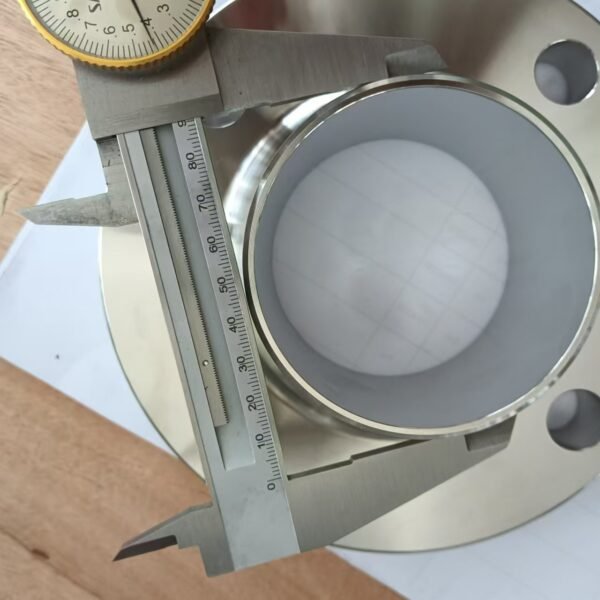
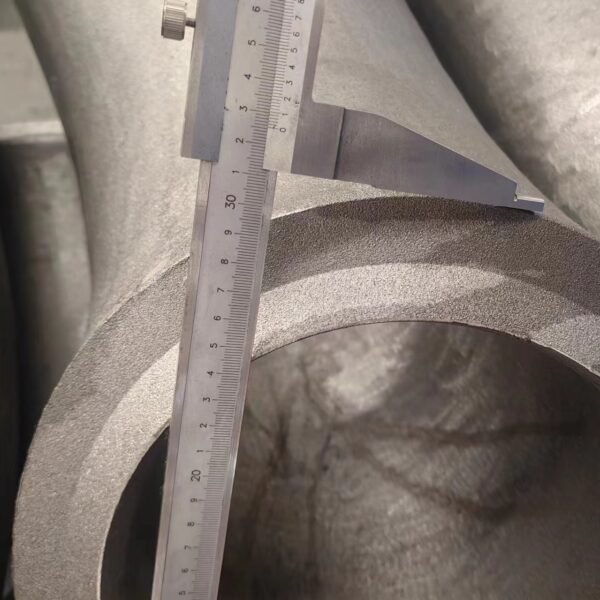
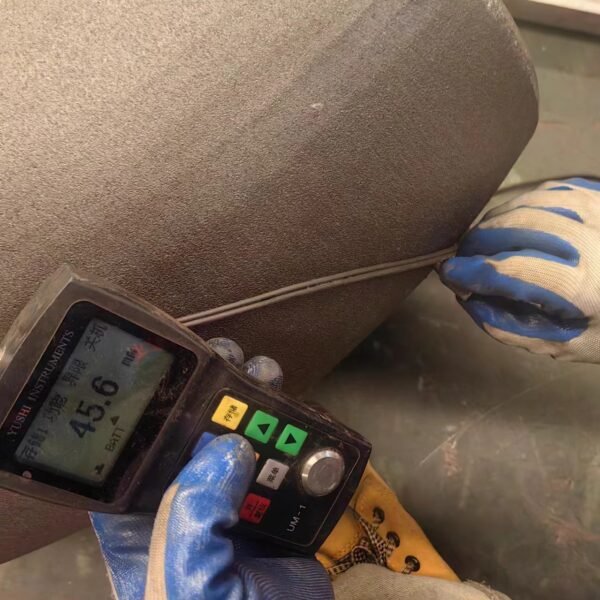
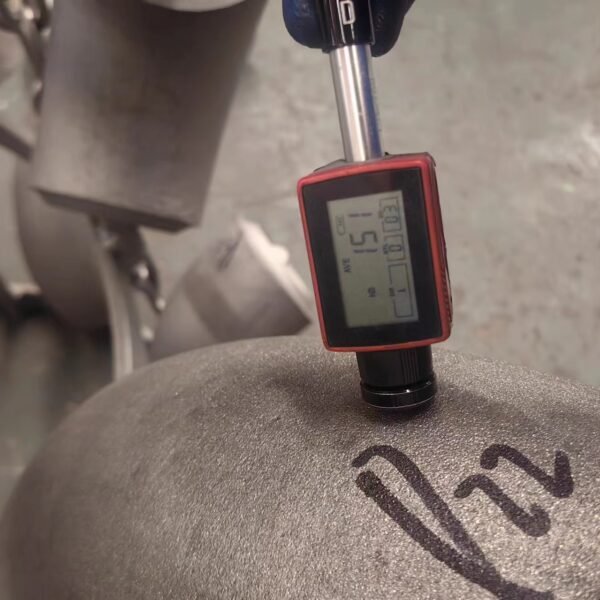
Material certification to EN 10204 Type 3.1 or 3.2 issued against the heat and the grade, dimensional inspection against ASME B16.11 Tables 1 and 2 including the socket bore, socket wall thickness and socket depth, and PMI on the finished fitting to confirm the nickel-chromium-iron chemistry and separate it from the molybdenum-bearing grades. Witnessed inspection and third-party certification can be arranged on request and should be named on the order.
The socket depth J in ASME B16.11 Table 1 is the minimum depth of the socket, which fixes how far the pipe has to enter before the fillet weld is made. It is a dimensional requirement of the fitting under 6.2.4 and it is what keeps the weld root in the right position relative to the bore. The socket bore itself is required by 6.2.5 to present a good workmanlike finish free of burrs, and the end flats must be at right angles to the socket axis under 6.2.6, because a socket that is not square will not take an even fillet weld.
Send the fitting type, size, class (3000, 6000 or 9000), quantity and any PMI or witnessed inspection requirement, and we will quote the Inconel 600 socket weld fittings.
Compare the supplier pages for this alloy family, each with dimensions, certification and RFQ information: