Address
304 North Cardinal St.
Dorchester Center, MA 02124
Work Hours
Monday to Friday: 7AM - 7PM
Weekend: 10AM - 5PM
Address
304 North Cardinal St.
Dorchester Center, MA 02124
Work Hours
Monday to Friday: 7AM - 7PM
Weekend: 10AM - 5PM

Alloy 20, also known as Carpenter 20, is a nickel-iron-chromium austenitic alloy developed for sulphuric acid service. The copper addition, combined with molybdenum, gives it a resistance to reducing acids that plain nickel-chromium alloys do not match, while chromium retains oxidation resistance. This page covers the flat product form to ASME SB-463.
ASME SB-463 covers UNS N08020 plate, sheet and strip in the stabilised-annealed condition. General requirements and permissible variations follow ASME B906 through Annex A1 of SB-463; where a conflict arises, SB-463 takes precedence. Matching forms:
| Grade | UNS | Ni | Cr | Mo | Cu | Nb+Ta | Key Characteristic |
|---|---|---|---|---|---|---|---|
| Alloy 20 | N08020 | 32.00-38.00 | 19.00-21.00 | 2.00-3.00 | 3.00-4.00 | 8 × C – 1.00 | Cu-bearing, sulphuric acid |
| Alloy 825 | N08825 | 38.0-46.0 | 19.5-23.5 | 2.5-3.5 | 1.5-3.0 | — | Similar acid duty, higher Ni |
| Alloy 30 | N06030 | Ni-Fe-Cr-Mo-Cu | — | — | Cu-bearing | — | More copper, stronger reducing acid |
Alloy 825 carries more nickel (38-46% against 32-38%) and less copper (1.5-3.0% against 3.0-4.0%) than Alloy 20, so Alloy 20 suits strong reducing sulphuric acid, while Alloy 825 suits combined acid and chloride exposure.
| Element | UNS N08020 (%) | Limit Type |
|---|---|---|
| Carbon | 0.07 max | max |
| Manganese | 2.00 max | max |
| Phosphorus | 0.045 max | max |
| Sulfur | 0.035 max | max |
| Silicon | 1.00 max | max |
| Nickel | 32.00-38.00 | range |
| Chromium | 19.00-21.00 | range |
| Molybdenum | 2.00-3.00 | range |
| Copper | 3.00-4.00 | range |
| Columbium (Nb) + tantalum | 8 × carbon – 1.00 | range |
| Iron | remainder | by difference |
The columbium-plus-tantalum requirement is tied to carbon content at 8 times carbon with a 1.00% ceiling. This stabilising addition ties up carbon as niobium carbide and prevents intergranular corrosion in the weld heat affected zone.
| Property | Requirement |
|---|---|
| Tensile strength, min | 80 ksi (551 MPa) |
| Yield strength (0.2% offset), min | 35 ksi (241 MPa) |
| Elongation in 2 in. (50.8 mm), min | 30.0% |
| Hardness, max | 217 Brinell or 95 Rockwell B |
Yield strength is determined by the offset method at 0.2% limiting permanent set per Test Methods B906. Elongation for material under 0.015 in. (0.38 mm) thick is 20% minimum in 1 in. (25.4 mm). Either Brinell or Rockwell B hardness is allowed.
SB-463 paragraph 5.1 requires the stabilised-annealed condition, with a recommended annealing temperature of 1800 to 1850°F (982 to 1010°C). Supplementary requirement S1 provides for corrosion testing: one intergranular corrosion test per lot, on a sensitised specimen, per ASTM A262 Practices. When specified, the applicable practice (B or E) must also be named; if Practice B is specified the specimen must pass at under 0.002 in. per month.
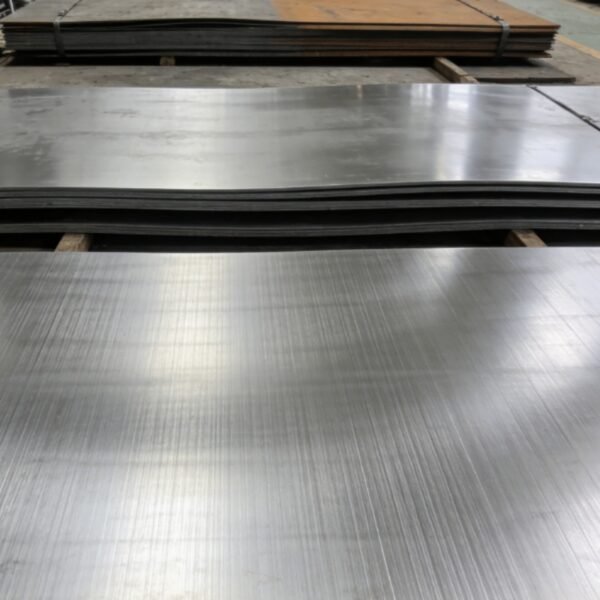
Plate, sheet and strip are supplied rolled, with thickness, width and weight tolerances governed by ASME B906 through Annex A1 of SB-463. Alloy 20 plate is used for acid storage tanks, agitator shells and absorption towers, as lining material or vessel shell.
Material is supplied with a mill test certificate per EN 10204 3.1 unless otherwise specified. Available inspection items include:
Please include the following when requesting a quotation:
Tell us the grade, dimensions and the acid service involved, and we will confirm the material, availability and an FOB quotation.
Related specifications and products. Alloy 20 is also supplied as fittings and flanges and as bar and wire. See our nickel alloy plate and sheet range Alloy 20 fitting and flange range Alloy 20 bar and wire for the dimensional and material basis behind this page.