Address
304 North Cardinal St.
Dorchester Center, MA 02124
Work Hours
Monday to Friday: 7AM - 7PM
Weekend: 10AM - 5PM
Address
304 North Cardinal St.
Dorchester Center, MA 02124
Work Hours
Monday to Friday: 7AM - 7PM
Weekend: 10AM - 5PM


The table below sets out the governing material specification and the grade comparison for Zirconium UNS R60702 / R60705 Plate, Sheet and Bar. All composition and mechanical values are taken directly from the ASME BPVC Section II specifications named in each row.
| Grade | UNS | Zr + Hf min, % | Hf max, % | Nb, % | Fe + Cr max, % | O max, % | N max, % |
|---|---|---|---|---|---|---|---|
| Unalloyed zirconium | R60702 | 99.2 | 4.5 | — | 0.2 | 0.16 | 0.025 |
| Zirconium-niobium | R60705 | 95.5 | 4.5 | 2.0–3.0 | 0.2 | 0.18 | 0.025 |
| Zirconium-tin | R60706 | 95.5 | 4.5 | — | 0.2 | 0.16 | 0.025 |
| Zirconium-tin | R60704 | 97.5 | 4.5 | — | 0.2 to 0.4 | 0.18 | 0.025 |
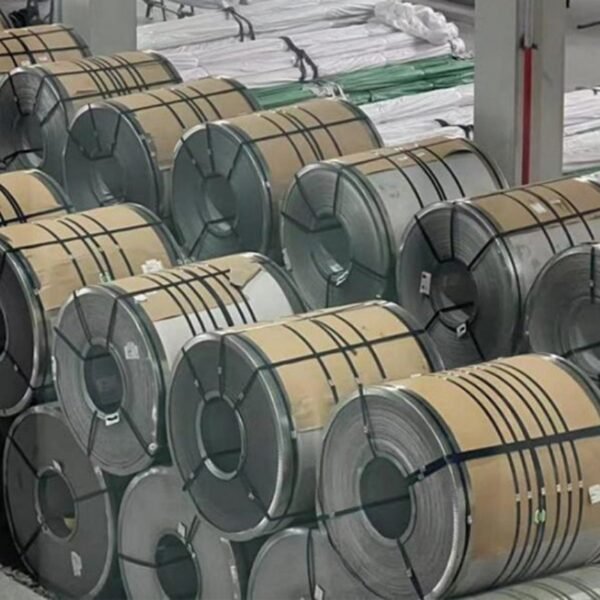
We supply zirconium plate, cold-rolled sheet and strip, hot-rolled and cold-drawn round bar, and wire in grades R60702 and R60705. Zirconium is also supplied in forged form to ASME SB-493 for valve bodies and pressure parts. Because zirconium is a niche material with limited mill availability, the size and thickness ranges we can offer depend on current stock — state the dimensions you need and we will confirm availability against our mill sources rather than quote a range we cannot support.
R60702 is unalloyed zirconium and offers the highest general corrosion resistance. R60705 adds 2.0–3.0 % niobium for improved strength and resistance to hydrogen pickup, and it is the preferred grade for higher-strength applications and for welds that will be heat-affected in service. Note that R60705 also carries a higher strength requirement than R60702 — tensile 80 ksi [550 MPa] against 55 ksi [380 MPa] and yield 55 ksi [380 MPa] against 30 ksi [205 MPa], with a tighter bend test radius of 3T against 5T. Grade selection between them should follow the specific acid concentration and temperature in your process. Where the service involves strong reducing conditions we can supply full material traceability with the mill test report.
Zirconium resists hydrochloric and sulphuric acid at concentration and temperature well beyond what nickel-molybdenum alloys tolerate, which makes it the economical answer for strong acid circulation systems, acid storage and heat exchanger parts. The constraint is different from nickel alloys: zirconium is vulnerable to fluoride attack, to oxidising environments at elevated temperature, and to hydrogen pickup under certain conditions. Fittings and flanges for zirconium service are produced from forgings to ASME SB-493 and are supplied on enquiry for specific sizes.
| Item | Requirement |
|---|---|
| Material specification | ASME SB-551 (plate, sheet and strip), SB-550 (bar and wire), SB-493 (forgings) |
| Grades | R60702 unalloyed zirconium; R60705 zirconium-niobium |
| Heat treatment | Solution annealed. For the columbium-bearing grades the recommended solution anneal consists of heating to a minimum temperature of 2000 °F (1090 °C) and cooling rapidly to room temperature |
| Corrosion test | Intergranular corrosion test capability; if specified on the order, specimens are sensitised 1 h at 1250 °F (677 °C) and tested per Practice C of Practices A 262 |
| Product forms | Plate, sheet, strip, rolled bar, forged bar, wire |
| Dimensional tolerances | SB-551 Tables 4–22 (thickness, width, length, flatness, camber, diameter and weight) |
Chemical composition shall conform to the applicable ASME specification. The table below reproduces the composition limits for the grades covered by Zirconium UNS R60702 / R60705 Plate, Sheet and Bar.
| Element | R60702 | R60705 |
|---|---|---|
| Zirconium + hafnium, min, % | 99.2 | 95.5 |
| Hafnium, max, % | 4.5 | 4.5 |
| Iron + chromium | 0.2 max | 0.2 max |
| Niobium, % | — | 2.0–3.0 |
| Hydrogen, max, % | 0.005 | 0.005 |
| Nitrogen, max, % | 0.025 | 0.025 |
| Carbon, max, % | 0.05 | 0.05 |
| Oxygen, max, % | 0.16 | 0.18 |
| Property | R60702 | R60704 | R60705 | R60706 |
|---|---|---|---|---|
| Tensile strength, min, ksi [MPa] | 55 [380] | 60 [415] | 80 [550] | 74 [510] |
| Yield strength, min, ksi [MPa] | 30 [205] | 35 [240] | 55 [380] | 50 [345] |
| Elongation in 2 in. or 50 mm, min, % | 16 | 14 | 16 | 14 |
| Bend test radius | 5T | 5T | 3T | 2.5T |
Zirconium is the standard material for hydrochloric acid handling above roughly 35 % concentration at elevated temperature, in absorbers, stripping columns, heat exchangers and acid piping in chlor-alkali and hydrochloric acid plants.
Strong sulphuric acid service in fertiliser and titanium-dioxide production plants, particularly in acid circulation and acid concentration duties, is a classic zirconium application.
Phosphoric acid evaporators and wet-process phosphoric acid corrosion zones use zirconium where the acid contains fluoride contaminants or where chlorides concentrate during evaporation.
Zirconium alloys have long been used for nuclear service and for specialty chemical equipment, and the same corrosion behaviour applies to non-nuclear chemical duty where no iron pick-up is permitted.
Full analysis to ASME SB-551 Table 1 for the applicable grade, with the certificate required before shipment.
Room temperature tensile properties per SB-551 Table 3, with bend testing on sheet and strip.
Solution annealed, with the recommended minimum solution anneal of 2000 °F (1090 °C) with rapid cooling for the columbium-stabilised grade.
Material shall be capable of passing; the test need not be performed on any given lot unless specified on the purchase order. When specified, specimens are tested in the sensitised condition, 1 h at 1250 °F (677 °C), per Practice C of Practices A 262, with a corrosion rate not exceeding 2.5 mils per month.
Surface free of scale and other defects from heat treatment, with dimensional inspection per the applicable SB-551 tolerance tables.
Mill test report with heat number traceability, and supplementary inspection on request.
Please specify the grade (R60702 or R60705), product form (plate, sheet, strip, bar, wire or forging), dimensions with the applicable tolerance basis, quantity, and the service environment including acid concentration, temperature and any fluoride contamination. We will confirm current availability, the material route, and issue a quotation on request. If the order requires an intergranular corrosion test, a specific surface condition, or third-party inspection, state this with the enquiry.