Address
304 North Cardinal St.
Dorchester Center, MA 02124
Work Hours
Monday to Friday: 7AM - 7PM
Weekend: 10AM - 5PM
Address
304 North Cardinal St.
Dorchester Center, MA 02124
Work Hours
Monday to Friday: 7AM - 7PM
Weekend: 10AM - 5PM

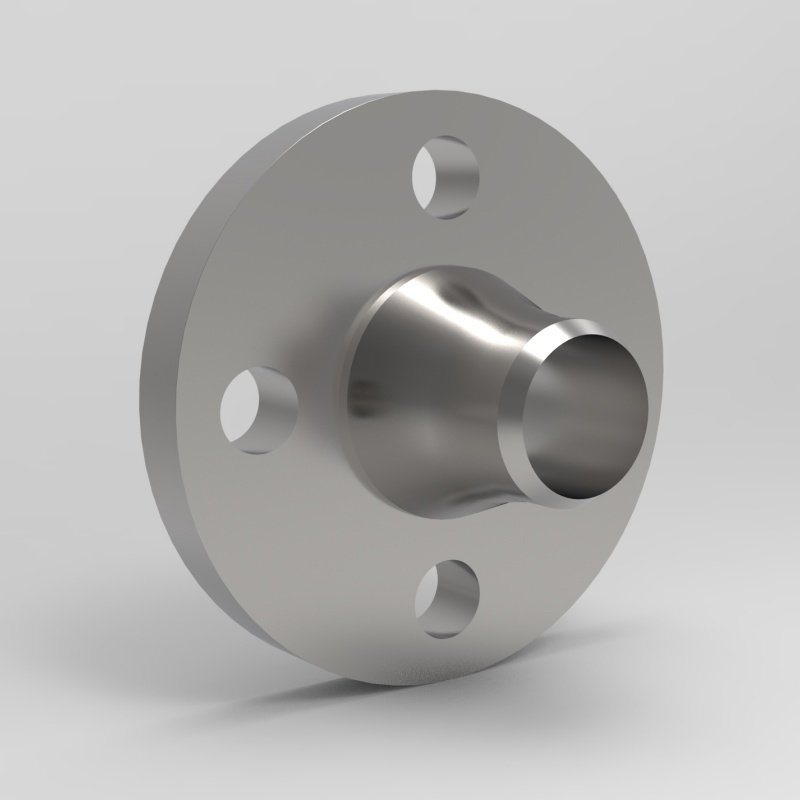
Monel 400 forged pipe flanges to ASME SB-564 and B16.5, UNS N04400. Weld neck, slip-on, socket weld, threaded and blind. EN 10204 3.1 MTC.
Monel 400 forged pipe flanges are the connection for the reducing environments that stainless steel cannot survive: hydrofluoric acid, deaerated sulphuric acid, caustic soda and seawater. UNS N04400 is a 67 % nickel, 30 % copper alloy and it does something no stainless steel does, namely it resists hydrofluoric acid, which attacks chromium oxide directly. The flange is the one component in the joint that has to be made from the same alloy as the pipe, because the corrosion mechanism is the alloy’s own rather than a coating that can be qualified separately.
ASME B16.5 gives the flange its geometry, its class and its marking; ASME SB-564 gives the forging its chemistry, its condition and its mechanical properties. Both belong on the order. For the butt weld fitting form of the same alloy see our Monel 400 butt weld fittings page.
| Designation | Value |
|---|---|
| UNS number | N04400 |
| Material specification | ASME SB-564 (nickel alloy forgings). ASME B16.5 Table 1A lists the grade in material group 3.4 as B 564 Gr. N04400, with B 127 Gr. N04400 for plate |
| Dimensional standard | ASME B16.5 (NPS 1/2 to NPS 24); ASME B16.47 (NPS 26 to NPS 60) |
| Rating table | ASME B16.5 Table 2-3.4, material group 3.4 |
| Material group | 3.4, nominal designation 67Ni–30Cu |
| Pressure class | Class 150, 300, 600, 900, 1500 and 2500 (Class 2500 to NPS 12 only) |
| Delivery condition | Annealed, per ASME SB-564 Table 2 |
| Marking | Per ASME B16.5 paragraph 4.2.3 and 4.2.8; nickel alloy forgings stamped in accordance with MSS SP-25 |
ASME B16.5 covers pressure-temperature ratings, materials, dimensions, tolerances, marking, testing and the method of designating openings for pipe flanges and flanged fittings in sizes NPS 1/2 through NPS 24, with rating class designations 150, 300, 400, 600, 900, 1500 and 2500, and Class 2500 applying to NPS 1/2 through NPS 12. For NPS 26 and larger ASME B16.47 takes over, covering welding neck and blind flanges in classes 75, 150, 300, 400, 600 and 900, in two dimensional series that are not interchangeable: Series A follows the former MSS SP-44 practice and Series B follows the former API 605 practice.
Two dimensional points decide whether a flange will actually mate. The first is the raised face height: ASME B16.5 paragraph 6.4.1 specifies that Classes 150 and 300 pipe flanges are regularly furnished with a 2 mm (0.06 in.) raised face and that Classes 400, 600, 900, 1500 and 2500 are regularly furnished with a 7 mm (0.25 in.) raised face, in each case in addition to the minimum flange thickness tf. A Class 150 flange therefore does not seat against a Class 600 flange without a gasket that tolerates the height difference. The second is the bore: ASME B16.5 note (7) to the dimension tables ties the bore to the inside diameter of B36.10M standard wall pipe, with Schedule 40 wall in NPS 10 and smaller, and paragraph 6.3.2 allows a raised face to be removed to convert a raised face flange to a flat face flange provided the required tf dimension is maintained.
Full dimension tables for Class 150 (Table F8), Class 300 (Table F11), Class 600 (Table F16) and Class 900 (Table F18) are published separately on this site in ASME B16.5 flange dimensions: Class 150, 300, 600 and 900, and the boundary between the two flange standards is covered in ASME B16.5 or B16.47: which flange standard applies at what size.
For this grade the flange types supplied are welding neck, slip-on, socket weld, threaded, lap joint and blind, with socket welding flanges produced to NPS 3 and smaller only. Welding neck is normally used where the flange is welded into the line, because the long hub spreads the bolt load into the pipe wall and the raised face stays concentric as the section expands. In an acid line that has to be opened periodically, a slip-on or threaded flange is often chosen instead so that the joint can be broken without cutting the pipe, and the corrosion allowance on that connection is carried by the flange face and the gasket rather than by the parent metal.
| Element | Composition, % (max unless stated) |
|---|---|
| Nickel | 63.0 min, determined by difference |
| Copper | 28.0 – 34.0 |
| Iron | 2.5 |
| Manganese | 2.0 |
| Carbon | 0.3 |
| Silicon | 0.5 |
| Sulfur | 0.024 |
| Phosphorus | not required by ASME SB-564 Table 1 |
| Chromium, molybdenum, niobium | not required by ASME SB-564 Table 1 |
Source: ASME SB-564 Table 1, chemical requirements for nickel-copper alloy UNS N04400. Nickel is determined by difference. The absence of chromium and molybdenum from the table is the whole point of the alloy: Monel 400 gets its corrosion resistance from nickel and copper, not from a passive chromium oxide film, which is why it handles hydrofluoric acid and reducing conditions that 316L cannot and why it has no chloride pitting resistance to fall back on in seawater. ASME SB-564 Supplementary Requirement S2.1 tightens the carbon, sulfur, aluminium, lead, tin, zinc and phosphorus limits for N04400 where that supplementary requirement is specified on the order.
| Property | Requirement |
|---|---|
| Tensile strength, min | 70 ksi (483 MPa) |
| Yield strength, 0.2 % offset, min | 25 ksi (172 MPa) |
| Elongation in 2 in. or 50 mm, min | 35 % |
| Condition | Annealed |
Source: ASME SB-564 Table 2, mechanical property requirements for nickel-copper alloy UNS N04400, annealed. ASME B16.5 note (1) to Table 2-3.4 requires annealed material only for this material group. For a hot finished or hot finished and hot tensile condition, ASME SB-564 Supplementary Requirement S3 refers to Table S3.1, and that condition has to be stated on the order if it is wanted.
| Temperature, °C | Class 150 | Class 300 | Class 400 | Class 600 | Class 900 | Class 1500 | Class 2500 |
|---|---|---|---|---|---|---|---|
| −29 to 38 | 15.9 | 41.4 | 55.2 | 82.7 | 124.1 | 206.8 | 344.7 |
| 50 | 15.4 | 40.2 | 53.7 | 80.5 | 120.7 | 201.2 | 335.3 |
| 100 | 13.8 | 35.9 | 47.9 | 71.9 | 107.8 | 179.7 | 299.5 |
| 150 | 12.9 | 33.7 | 45.0 | 67.5 | 101.2 | 168.7 | 281.1 |
| 200 | 12.5 | 32.7 | 43.6 | 65.4 | 98.1 | 163.5 | 272.4 |
| 250 | 12.1 | 32.6 | 43.5 | 65.2 | 97.8 | 163.0 | 271.7 |
| 300 | 10.2 | 32.6 | 43.5 | 65.2 | 97.8 | 163.0 | 271.7 |
Source: ASME B16.5 Table 2-3.4, pressure-temperature ratings for group 3.4 materials, expressed in bar. The table also covers 67Ni–30Cu–S, UNS N04405. Note that the Class 150 rating of 15.9 bar at ambient is lower than the 20.0 bar of group 3.8, so a Monel 400 flange is frequently the limiting component in a joint that mates to an Inconel 625 flange of the same class. Intermediate temperatures may be interpolated linearly between tabulated values.
Monel 400 flanges are forged from billet and furnished annealed, with the machining and drilling carried out after the heat treatment. ASME SB-564 requires the product to be supplied annealed and ASME B16.5 note (1) to Table 2-3.4 allows only annealed material for the pressure rating. The surface is pickled, and the sealing face is machined to the finish the gasket requires.
Two process points matter for this alloy specifically. The first is sulphur. Monel 400 has good resistance to reducing acids but it is vulnerable to sulphur-bearing contamination during welding, so the filler metal and the joint cleaning both have to be controlled; this is a fabrication discipline rather than a material limit, but it is the reason a qualified procedure is written into the order rather than left to the shop. The second is the fact that the annealing condition changes the mechanical properties appreciably. The annealed condition quoted above gives a 25 ksi yield and 35 % elongation; a hot finished or stress-relieved condition gives higher strength and much lower elongation, and a flange chosen on strength alone can end up too stiff to seat. ASME SB-564 Supplementary Requirement S3 and Table S3.1 cover those conditions and have to be invoked on the order.
Supplementary testing on this grade is supplied when it is named on the order rather than assumed: hardness testing, charpy impact testing, ultrasonic or eddy current examination, positive material identification and liquid penetrant examination. Where the grade is going into hydrofluoric or sulphuric acid service, the material certificate should be reviewed against the specific limits in ASME SB-564 Supplementary Requirement S2.1 for UNS N04400, which tighten carbon, sulfur, aluminium, lead, tin, zinc and phosphorus for applications where those trace elements matter.
Each flange is marked with the material grade and specification, the nominal
size, the pressure class and the heat number. The rating designation number
corresponding to the pressure rating class is applied to the flange in accordance
with ASME B16.5. Where the flange is made from a material that meets more than one
specification or grade, the marking procedure of ASME B16.5 for multiple material
marking is followed. Nickel alloy forgings are stamped in accordance with MSS SP-25
in a position that does not impair the usefulness of the forging. B16.5 also
permits the manufacturer to supplement the mandatory material indications with a
trade designation, provided confusion of symbols is avoided.
Flanges are supplied in the annealed condition, pickled, with a machined sealing
face. Each flange carries the grade, the governing material specification, the
dimensional standard, the nominal size, the pressure class and the heat number,
linked to the EN 10204 certificate issued with the shipment. Export packing is by
wooden crate, steel pallet or case, with plastic end caps and, where required, VCI
protection inside the case. Flange facings are protected individually so that the
sealing surface is not marked in transit. Delivery schedule, quantity, minimum
order quantity and price are confirmed only against a specific enquiry.
Monel 400 flanges are specified in hydrofluoric acid alkylation units and in the acid handling side of a refinery, in deaerated and oxygen-free sulphuric acid service, in caustic soda and caustic potash evaporators and crystallisers, in the pulp and paper bleaching and washing plant, in alkalis and salts, in seawater and brackish water piping, and in the handling of food and pharmaceutical products where the alloy is used for its inertness rather than for its strength. It is also used for the saltwater systems of ships and for oil and gas service where sulphur compounds are present.
Monel 400 is a reducing-environment alloy, and the flange is usually the limiting component. ASME B16.5 Table 1A places UNS N04400 in material group 3.4, whose rating table 2-3.4 gives a Class 150 ambient rating of 15.9 bar. Material group 3.8, which carries Inconel 625 and Hastelloy C-276, gives 20.0 bar for the same class. So in a line that transitions from a nickel-copper section to a nickel-chromium-molybdenum section at a bolted joint, the Monel 400 flange is the one with less margin, whatever the pipe specification says. Sizing the joint on the pipe rating rather than the flange rating is a common way to overrate a Monel 400 flange.
Why there is no chromium and no molybdenum in the table. ASME SB-564 Table 1 shows no requirement for chromium, molybdenum or niobium in UNS N04400. That is not an omission in the specification, it is the definition of the alloy. Monel 400 resists corrosion by the noble behaviour of nickel and the reducing-acid passivation of copper, not by a chromium oxide film. That gives it the ability to handle hydrofluoric acid, which strips chromium oxide from 316L and leaves the alloy as bare iron and chromium, and it gives it resistance to reducing acids that austenitic stainless steels do not have. The same mechanism removes the alloy’s defence against chlorides: there is no chromium to form the passive film and no molybdenum to stabilise it, so pitting in seawater is a live risk and the flange has to be protected by design rather than by composition.
The condition has to be written on the order. ASME SB-564 Table 2 gives the annealed condition, and B16.5 note (1) to Table 2-3.4 allows nothing else for the rating. But ASME SB-564 Supplementary Requirement S3 also covers hot finished and hot finished and hot tensile conditions in Table S3.1, where the strength is higher and the ductility considerably lower. Monel 400 is a forgiving alloy to form and a poor one to seat if it is over-strengthened, and the difference between 35 % elongation in the annealed condition and the much lower figure in the stress-relieved condition is exactly what decides whether a raised face seats evenly. Where the design calls for a specific condition, the order has to say which one, and which of the two supplementary tables applies.
ASME SB-564 covers the forgings, with UNS N04400 in its scope, and ASME B16.5 covers the dimensions, pressure classes and marking up to NPS 24. ASME B16.47 covers NPS 26 and above. Write both standard numbers on the purchase order.
Yes, and they are a long-established choice for seawater and brackish water, but the mechanism is different from stainless steel. Monel 400 relies on nickel and copper rather than on a chromium oxide passive film, so it handles reducing conditions that 316L cannot while offering no molybdenum-assisted pitting margin in chlorides.
Annealed, per ASME SB-564 Table 2, and ASME B16.5 note (1) to Table 2-3.4 requires annealed material only for the pressure rating. Hot finished and hot finished and hot tensile conditions are covered by ASME SB-564 Supplementary Requirement S3 and Table S3.1 and have to be specified.
Monel 400 is material group 3.4 and rates at 15.9 bar at Class 150 ambient. Inconel 625 is material group 3.8 and rates at 20.0 bar at the same class, so a Monel 400 flange is usually the limiting component in a joint that mates to a 625 flange of the same class.
Welding neck, slip-on, socket weld, threaded, lap joint and blind, with socket welding flanges to NPS 3 only, per ASME B16.5. Welding neck is normally used where the flange is welded into the line.
Classes 150 and 300 are regularly furnished with a 2 mm (0.06 in.) raised face and Classes 600 and 900 with a 7 mm (0.25 in.) raised face, in addition to the minimum flange thickness tf, per ASME B16.5 paragraph 6.4.1. The mating flange has to have the same height.