Address
304 North Cardinal St.
Dorchester Center, MA 02124
Work Hours
Monday to Friday: 7AM - 7PM
Weekend: 10AM - 5PM
Address
304 North Cardinal St.
Dorchester Center, MA 02124
Work Hours
Monday to Friday: 7AM - 7PM
Weekend: 10AM - 5PM


Hastelloy B-2 (N10665) and B-3 (N10675) nickel-molybdenum butt weld fittings to ASME SB-366 and B16.9. Ni-Mo for HCl, wet chlorine and reducing acids.
Hastelloy B-2 and B-3 are the only essentially binary nickel-molybdenum alloys in commercial use: roughly 26–30% molybdenum with nickel as the balance and essentially no chromium. That composition is the whole point. Molybdenum confers resistance to reducing environments — hydrochloric acid, wet chlorine gas, sulphuric acid and phosphoric acid — while the absence of chromium deliberately removes the oxidising-acid and localised-corrosion resistance that chromium provides. Buyers who substitute a chromium-bearing grade into a reducing service are the single most common source of premature failure we see, so grade identification matters more here than in almost any other alloy family.
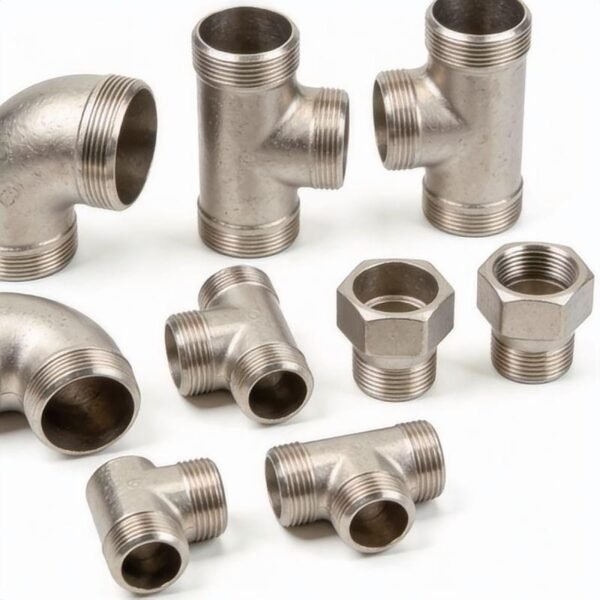
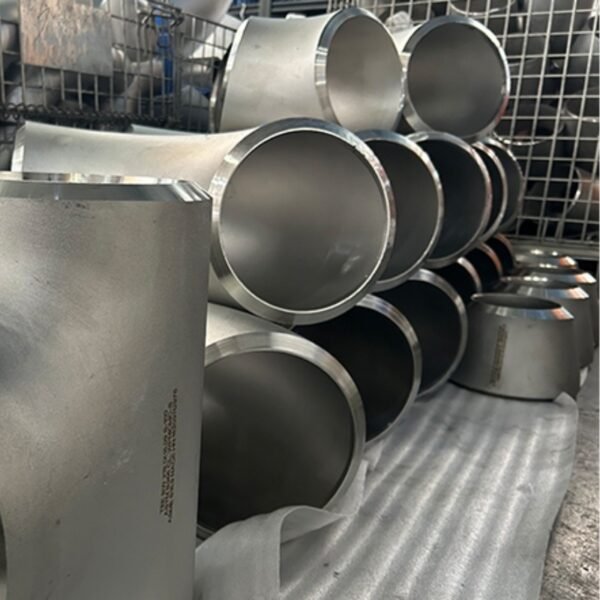
We supply B-2 and B-3 butt weld fittings to ASME B16.9 — 45°, 90° and 180° elbows, equal and reducing tees, concentric and eccentric reducers, caps and lap-joint stub ends. Socket weld and threaded forms to ASME B16.11 are available on request. Fittings are supplied solution annealed and rapidly air- or water-quenched, with bevelled ends ready for welding. MSS SP-43, SP-95 and SP-97 covering geometries are also produced.
| ASME spec | Product form | Grades (UNS) |
|---|---|---|
| SB-366 / SB-366M | Wrought BW & SW fittings | N10665 (B-2), N10675 (B-3) |
| SB-333 | Plate, sheet, strip | N10001, N10665, N10675, N10629, N10624 |
| SB-335 | Rod | N10665, N10675 |
| SB-626 | Welded tube | N10665, N10675 |
| SB-462 | Forged flanges & fittings | N10665, N10675 |
| SB-564 | Forgings | N10665, N10675 |
| Element | B-2 (N10665) | B-3 (N10675) |
|---|---|---|
| Nickel | Remainder | 65.0 min |
| Molybdenum | 26.0–30.0 | 27.0–32.0 |
| Iron | 2.0 max | 1.0–3.0 |
| Chromium | 1.0 max | 1.0–3.0 |
| Carbon, max | 0.02 | 0.01 |
| Silicon, max | 0.10 | 0.10 |
| Cobalt, max | 1.00 | 3.0 |
Note the practical difference: B-3 carries a higher molybdenum floor (27.0%) and a minimum nickel content, plus slightly more chromium and cobalt. Where a specification calls out B-2 by name, do not silently upgrade to B-3 — the two are not interchangeable in a mixed inventory.
| Property | B-2 (N10665) | B-3 (N10675) |
|---|---|---|
| Tensile strength, min | 110 ksi (760 MPa) | 110 ksi (760 MPa) |
| Yield strength (0.2% offset), min | 51 ksi (350 MPa) | 51 ksi (350 MPa) |
| Elongation in 2 in., min | 40% | 40% |
Both grades are annealed at 1950 °F [1065 °C] and rapidly air- or water-quenched. This is a set-point temperature, not a range — a common source of non-conformance when a fabricator substitutes a generic 2050 °F nickel-alloy cycle.
Hastelloy B alloys are specified for hydrochloric acid pickling and regeneration, hydrofluoric acid alkylation equipment, wet chlorine and chlorine dioxide handling, sulphuric and phosphoric acid systems, organic acid and esterification service, and pulp and paper bleaching equipment. They are not the correct choice for oxidising or aerated service, or for seawater — for those environments C-276, C-22 or Alloy 686 are the correct selections.
EN 10204 3.1 mill test certificates as standard; 3.2 available on request. PMI verification, tensile testing per furnace charge, hardness testing and ferrite-content checks available. Intergranular corrosion testing to ASTM G-28 on request for service qualification.
Send NPS size, wall thickness or schedule, quantity, grade (B-2 or B-3), end preparation and required certification. If you are substituting from a failed component, tell us the service media and temperature — we will confirm grade suitability before quoting.